
Welcome to the future of web development! As we journey into 2025, the landscape of technology is evolving at an unprecedented pace, and React JS remains at the forefront of this transformative wave. In this blog, we are excited to unveil the ultimate React tech stack of 2025, a game-changer for developers and businesses alike.
Whether you’re looking to harness the power of React JS Development Services or aiming to Hire React JS Developers who are experts in this cutting-edge technology, you’re in the right place.
Join us as we examine the cutting-edge techniques and technologies that will take your web development efforts to entirely new levels in the dynamic world of React.
Take your projects to new heights – choose us for exceptional ReactJS web development services.
Read More About: Boosting User Experience: The Secret Benefits of Using React.js
Understanding the React Ecosystem
Before we embark on our quest to select the appropriate tech stack, take some time to comprehend the React ecosystem. React is a JavaScript library that Facebook created and maintains to aid in the creation of user interfaces. It is a preferred choice among developers all around the world due to its component-based architecture, virtual DOM, and reactivity.
Why is React Important?
Reusability:
React’s component-based methodology enables developers to produce reusable UI elements, cutting down on duplication and expediting development.
Performance:
By reducing DOM operations, the virtual DOM speeds up rendering and improves user experience.
Community and Resources:
Since React has a large and dynamic community, there are tonnes of resources, libraries, and third-party applications available.
Best Javascript Frameworks For Web And App Development
The Significance of a Well-Chosen Tech Stack
Imagine React as the engine of a sports car; it provides the power and speed. However, the tech stack is the chassis, tires, and fuel that determine how well the car performs. A well-chosen tech stack can enhance React’s capabilities and streamline development.
Key Considerations
1. Project Requirements:
The first step in selecting a React tech stack is to understand your project’s unique requirements. Take into account elements like project scope, difficulty, scalability, and the particular features you must build.
2. Developer Expertise:
Evaluate your development team’s expertise. Are they well-versed in certain technologies that can complement React? Choosing a stack that aligns with your team’s skills can boost productivity.
3. Performance Goals:
Different projects have different performance requirements. Determine whether your project requires real-time functionality, high performance, or other particular performance parameters.
4. Community and Support:
Examine whether third-party libraries, documentation, and community support are available for the technology you intend to use. A strong community can be a valuable resource.
How to Integrate OpenAI into Your React Web App
Looking for skilled professionals?
We offer top-tier
.
React Tech Stack Selection: Your Roadmap to Success
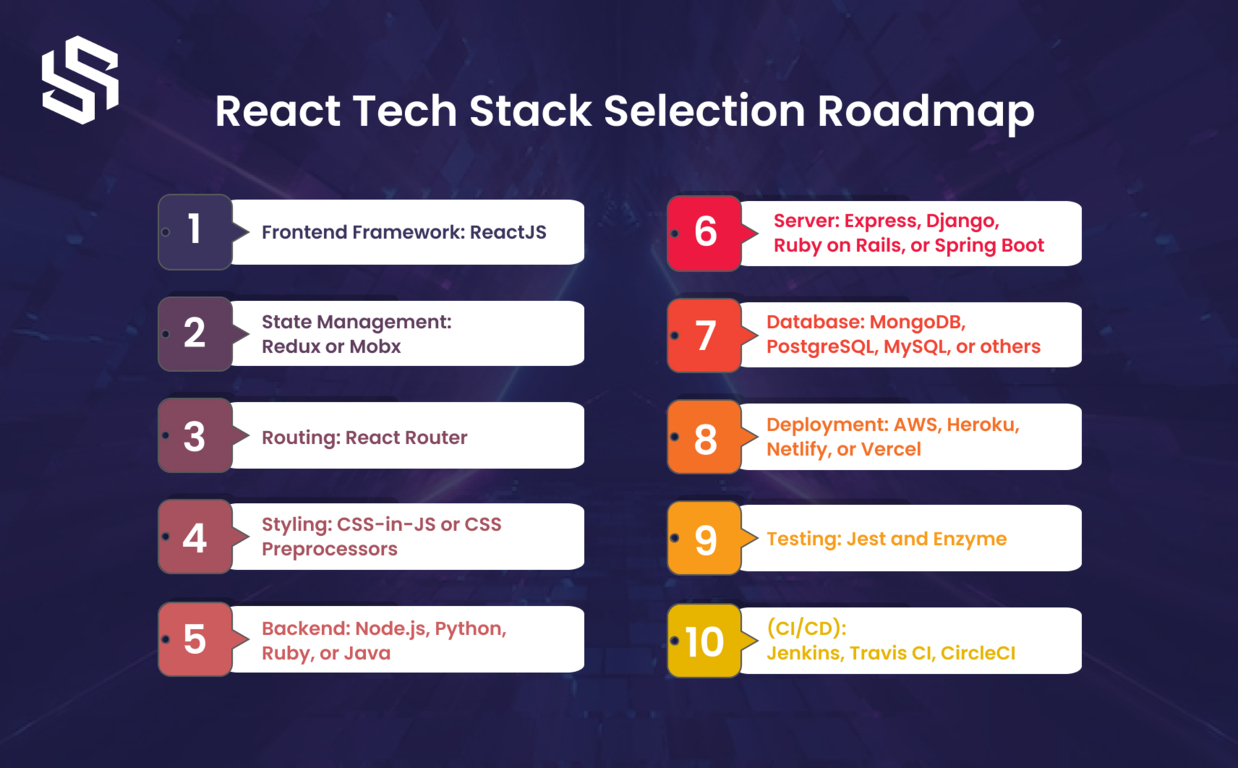
Now let’s get specific about building your React tech stack.
As we explore each layer of the stack, from frontend and backend through development and deployment.
1. Frontend Framework: ReactJS
At the core of your tech stack is ReactJS. It will handle the user interface, ensuring a responsive and interactive web application.
Top 10 Frontend Frameworks for Web Development
2. State Management: Redux or Mobx
For complex applications, efficient state management is crucial. Redux and Mobx are popular choices, each with its own strengths. Redux provides a centralized store, while Mobx offers simplicity and flexibility.
3. Routing: React Router
To enable seamless navigation within your single-page application, React Router is the go-to solution. It allows you to define routes and handle navigation with ease.
Mastering Single Page Applications: A Complete Guide
4. Styling: CSS-in-JS or CSS Preprocessors
Styling is an integral part of any web application. You can choose between CSS-in-JS libraries like styled-components or traditional CSS preprocessors like SASS or LESS, depending on your preferences and project requirements.
5. Backend: Node.js, Python, Ruby, or Java
Selecting the backend technology depends on your team’s expertise and project needs. Node.js is a popular choice for its JavaScript synergy with React, while Python, Ruby, and Java offer robust alternatives.
Top 11 Backend Frameworks for web development
6. Server: Express, Django, Ruby on Rails, or Spring Boot
The server framework you choose should align with your backend technology. Express for Node.js, Django for Python, Ruby on Rails for Ruby, and Spring Boot for Java are all solid options.
7. Database: MongoDB, PostgreSQL, MySQL, or others
The choice of a database system depends on factors like data structure, scalability, and project requirements. MongoDB for NoSQL, PostgreSQL for relational databases, and MySQL are common selections.
8. Deployment: AWS, Heroku, Netlify, or Vercel
Select a reliable hosting platform that suits your project’s scalability and deployment needs. AWS, Heroku, Netlify, and Vercel are popular choices for hosting React applications.
9. Testing: Jest and Enzyme
To ensure the reliability of your application, incorporate testing into your tech stack. Jest for unit testing and Enzyme for React component testing are widely adopted tools.
10. Continuous Integration and Deployment (CI/CD): Jenkins, Travis CI, CircleCI
Automate your development pipeline with a CI/CD tool. Jenkins, Travis CI, and CircleCI can help streamline testing and deployment processes.
| Section | Technology/Framework | Description |
|---|---|---|
| Introduction | React | A JavaScript library for building user interfaces, providing a component-based architecture and virtual DOM. |
| Building Blocks | JavaScript | The fundamental scripting language for React development. |
| ES6 (ECMAScript 2015) | The latest version of JavaScript, introducing powerful features like arrow functions and template literals. | |
| Styling | CSS | Cascading Style Sheets for styling your React components. |
| CSS Preprocessors (e.g., Sass, Less) | Advanced styling options with features like variables and mixins. | |
| Managing State | Redux or Context API | Redux offers centralized state management, while Context API provides a lighter-weight option within components. |
| Routing | React Router | A library for adding routing and navigation to React applications, enabling multi-page functionality. |
| API Requests | Axios or Fetch | Axios simplifies HTTP requests, while Fetch is the native browser API for making requests. |
| Bundling and Build Tools | Webpack | A module bundler for optimizing asset management. |
| Babel | A transpiler that converts modern JavaScript into browser-compatible code. | |
| Testing | Jest | A JavaScript testing framework for testing React components and applications. |
| React Testing Library | A library for testing React components with a focus on user behavior. | |
| Deployment | Hosting (e.g., Netlify, Vercel, AWS Amplify) | Platforms for hosting React applications. |
| CI/CD (e.g., GitHub Actions, Travis CI) | Continuous Integration/Continuous Deployment services for automating deployment workflows. |
React 18: Release Guide, New Features and Latest Updates
Top 5 Most Popular React Libraries
Next.js: The Best React Framework
The most popular React framework is Next.js, which provides server-side rendering, routing, and a fantastic developer experience. It is a top option for creating cutting-edge web apps due to its simplicity of use and robust capabilities.
Redux: The Go-To State Management Library
Redux remains a cornerstone of React state management. It provides a centralized store, making it easier to manage complex application states. While Context API is an alternative, Redux’s popularity endures.
Apollo or React-query: Quickly Getting Data
When it comes to data fetching in React, two libraries have gained prominence: react-query and Apollo. React-query simplifies server-state management, while Apollo excels in handling GraphQL queries.
React Hook Form: Form Handling Streamlined
For form management, React Hook Form shines. Its simplicity and performance make it a preferred choice among developers, allowing efficient handling of form state and validation.
Styled-components or MUI: Making Stunning UIs
The choice of UI library often boils down to styled-components or Material-UI (MUI). Styled-components enables CSS-in-JS, while MUI offers pre-designed components for a consistent and attractive UI.
Next JS vs React – Which JavaScript Framework to Use?
Top 3 Most Popular Developer Tools for React
Prettier: Simple Code Formatting
Prettier is the go-to tool for code formatting. It enforces consistent code styles across your project, ensuring clean and readable code.
ESLint: Catching Problematic Patterns
ESLint plays a crucial role in maintaining code quality. It identifies and fixes problematic patterns, ensuring adherence to coding standards and best practices.
TypeScript: Reliability Checking of Types
TypeScript enhances code reliability by introducing static typing to your React project. It helps catch errors early in development, leading to more robust applications.
Your Path to Excellence in React Development Starts Here – Hire Dedicated React Developers.
Top 4 Most Popular React Testing Frameworks and Tools
Jest: The Ultimate React Testing Framework
Jest is an undisputed leader in React testing frameworks. Unit testing is a breeze thanks to the broad set of testing tools it offers.
React Testing Library: Streamlining Integration Testing
For integration testing in React, the React Testing Library is a top choice. It focuses on testing your application from a user’s perspective and ensuring a better user experience.
Cypress: Excellence in End-to-End Testing
With real-time browser previews and an intuitive interface, Cypress excels at end-to-end testing. It’s an excellent choice to ensure your application works seamlessly.
Storybook: User Interface Testing and Documentation
This enables a more effective development approach by allowing you to create, test, and document individual components independently.
Dedicated Developers Vs Freelancers: Which One to Hire?
Most Popular React Developer Workflows
Trunk Based Development: Streamlining Collaboration
Trunk Based Development, a Git workflow, promotes collaboration by encouraging developers to frequently merge their work into the main branch. It minimizes integration challenges and accelerates development.
Summary: An Advanced React Learning Path
Following our examination of the most well-liked React libraries, developer tools, testing frameworks, and processes, the following is a pre-designed learning route for developing your React proficiency:
Learn Trunk Based Development:
Familiarize yourself with the Trunk-Based Development Git workflow for efficient collaboration.
Use Next.js:
Dive into Next.js to harness the power of server-side rendering and routing.
Optional:
Use TypeScript: Incorporate TypeScript for enhanced type checking and code reliability.
Use ESLint:
Implement ESLint to maintain code quality and catch problematic patterns.
Use Prettier:
Integrate Prettier for consistent code formatting and improved readability.
Use styled-components or MUI:
Choose between styled components and MUI to craft visually stunning user interfaces.
Write Tests with Cypress:
Master end-to-end testing with Cypress to ensure your application’s functionality.
Optional – Use Redux:
Explore Redux for state management if your project demands complex state handling.
Optional – Use Storybook:
Consider Storybook for efficient UI testing and documentation.
Take Your Web Development to the Next Level – Connect with Our ReactJS Development Experts Now!
The Cost of Hiring React Developers
Wrapping It Up
As you set forth in your quest to choose the ideal React tech stack for 2025, remember that adaptability is your greatest ally. Recognize that there is no one answer that fits all situations and what works for one project could not work for another. Continuously evaluate your project’s unique needs, stay abreast of emerging technologies, and be receptive to experimenting with new tools. Success in the constantly changing web development world is definitely within grasp with the correct React tech stack.
Moreover, when it comes to crafting the perfect React tech stack, it’s about more than just assembling a list of technologies; it’s about architecting your success. React, in the capable hands of experts like Yash Patel, offers incredible potential. Yash Patel, who is well-versed in every aspect of React development, leads the charge to ensure your projects not only meet but exceed expectations.
As a React JS development company, our mission is crystal clear: to empower your digital journey. Whether you’re looking to hire dedicated React JS developers or seek guidance, we’re here to elevate your development endeavors. The future of web development is at your fingertips with the appropriate tech stack and our unwavering dedication to quality. Connect with us today and embark on a journey towards unparalleled web development success.