

In the current state of the digital economy, customer behaviors are shifting in cornerstone ways. The simplicity of a search bar hosting basic ecommerce functions is clearly insufficient to accommodate any consumer’s set of needs today. Ecommerce artificial intelligence technologies are transforming consumer relations with online shops to be more hands-on, personal, and immersive. This is positive not only from the customer satisfaction perspective but also substantively boosts revenues for many businesses that invest in these new technologies.
The Change of Product Discovery
Ecommerce technologies and product discovery stand to benefit from the innovations made in AI. Algorithms performing online queries based on string searches and website sections still represent the very basis of ecommerce. While useful, the functionality of these approaches is not sufficient given the more sophisticated demands posed by today’s shoppers. Executives, for instance, may be ordering “comfortable work shoes”, but the supply of such shoes is tailored to those requiring vastly different professional comfort features.
AI for ecommerce alleviates this issue with innovative context-aware behavioral learning and need-predicting discovery systems that work with remarkable precision. Artificial intelligence in the retail industry is maturing, transforming the product discovery, recommendation, and presentation processes.
Why Traditional “Search” Doesn’t Work
Before we delve into the generative AI revolution, it is essential to understand the shortcomings of earlier conventional search systems:
Lack of Intent Recognition
Underlying shopper intent is often considered irrelevant due to traditional search algorithms being solely dependent on keyword matching. Searching for a “lightweight laptop”, for example, returns any product whose description has the words “lightweight” and “laptop” without even attempting to understand the meaning of those words in the customer’s context.
Difficulty Understanding Natural Language
Systems that rely on language to generate answers to queries are not equipped to handle everyday language, such as “I need something to wear to a beach wedding next month that won’t make me sweat too much.” These systems are command-based, not conversation-based.
Bad Dealing with the Ambiguity
Searches stall when product descriptions conflict among vendors, each employing different vernacular for industry-specific terms. For example, differing clients might refer to “jumpers” as “sweaters” or “pullovers”.
Static Rankings of Relevance
Legacy systems completely ignore every market trend or consumer perception shift due to static, pre-defined relevance signals, which are the basis of their operation.
Generative AI: Transforming Product Discovery
The introduction of LLMs and multimodal systems clearly indicates how generative AI transforms product discovery for ecommerce application development services. Here is how this change is unfolding.
Conventional AI-powered ecommerce platforms can now enable shoppers to express verbal requirements. Rather than capturing basic keywords into their searching algorithms, customers can state complex phrases such as “waterproof camera that functions perfectly beneath water and is under the price of $300.” AI returns accurate results for such complex requests.
Transforming the approach to dealing with clients is welcomed because it captures the intricacy of human preferences. This method benefits products with many specifications or use cases that traditional filters cannot articulate.
Visual Search and Recognition
The most current (“cutting edge”) visual search functionalities, which enable customers to upload photos and retrieve visually similar products, have also been integrated into AI solutions for ecommerce. This is very useful within the verticals of fashion, home décor, and design because the aesthetic attributes of a product are hard to translate into language.
For instance, a customer sitting in a café can quickly find similar options for a stylish lamp by snapping its photo. This visual discovery method eliminates the bounds of textual descriptions.
Semantic Understanding and Contextual Awareness
Modern Artificial Intelligence systems have reached a point at which they recognize not just keywords but also concepts and the relationships that exist between them. An AI can find relevant products by interpreting the user’s query, “business casual outfits for summer,” within the context of the summer season, business category, and intended occasion. In this case, the AI would also show items that fit the category even if those specific words weren’t used in the product descriptions.
This kind of intuitive reasoning enables people to navigate and discover products online in a more human-centered way.”
Read More About Generative AI in eCommerce: A Smarter Way to Increase Sales and Profits
How Generative AI Enhances Product Discovery
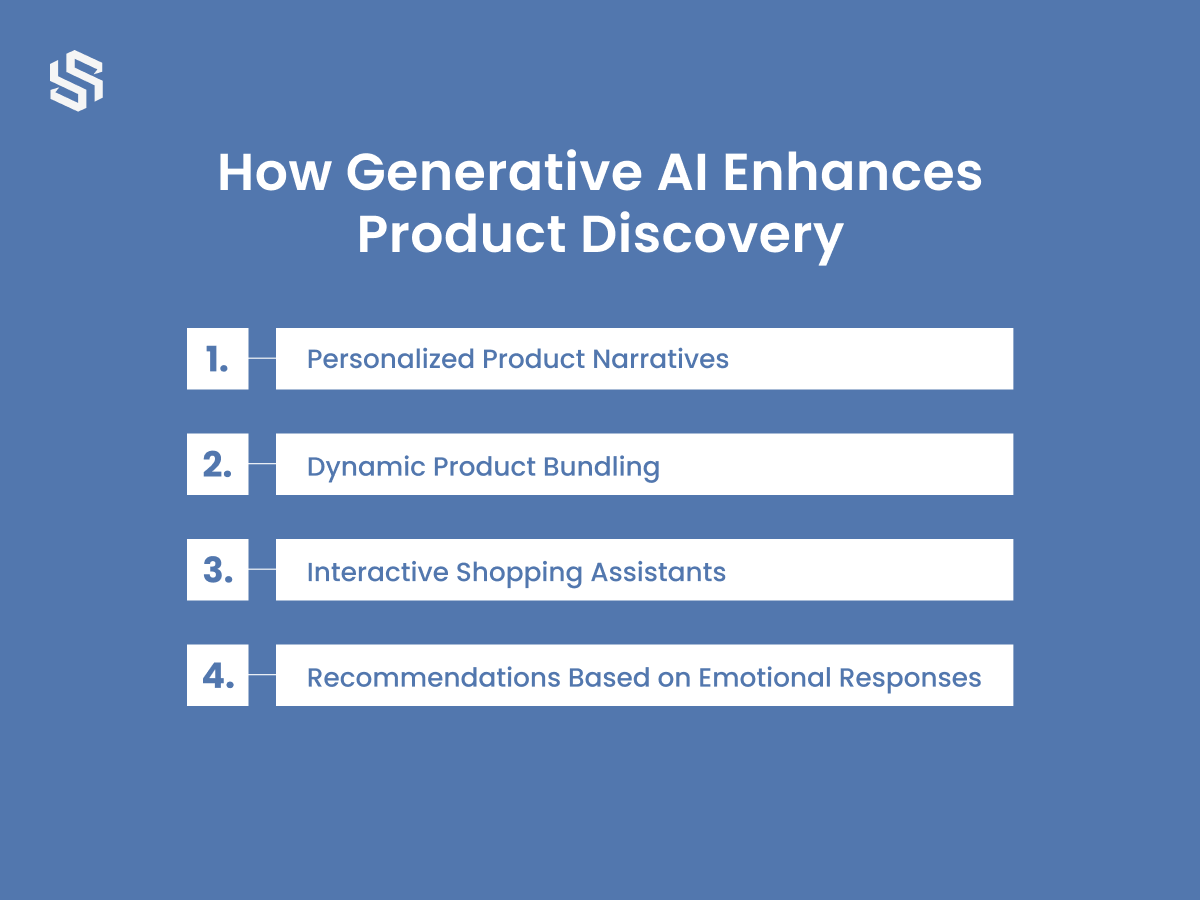
Personalized Product Narratives
Generative AI has taken ecommerce to a new level for AI-enabled ecommerce by enabling it to create relevant and personalized product narratives for specific customers. That is one of its many powerful functionalities. Instead of having a one-size-fits-all approach to product descriptions, AI for ecommerce can customize them to highlight the most relevant and impactful points for individual customers.
Taking the example of a customer interested in sustainability, the AI could showcase a product’s eco-friendly manufacturing processes. For a spendthrift shopper, it could highlight how purchasing the product saves money in the long run. Such narratives help consumers relate and connect with the products in a personalized way.
Dynamic Product Bundling
Generative AI is unparalleled when identifying different products and useful add-ons a customer might need based on the customer’s purchasing pattern and sophisticated understanding of product relationships. It enables dynamic product bundling far beyond “frequently bought together” recommendations.
For example, when a customer shops for a DSLR camera, the AI could offer a tailored package with appropriate lens selection relevant to the photography style the customer has previously expressed interest in, other relevant storage devices, and level-appropriate accessories.
Interactive Shopping Assistants
AI-powered ecommerce technology can create online shopping assistants that converse with users and carry out complex two-way discussions. These assistants can do much more than respond to simple queries; they can aid in narrowing down preferences, recommend other options, compare alternatives, and even provide expert tips.
Imagine a client searching for running shoes. An AI shopping assistant could question them about their running style, foot, previous brand experiences, and preferred terrains, and then recommend shoes that align with those needs.
Recommendations Based on Emotional Responses
The most recent developments in artificial intelligence in retail technology reveal that systems are beginning to detect and act on purchasing emotions. By examining shopping behaviors such as browsing patterns, the time spent in an online shop, and text sentiment in reviews, artificial intelligence can recommend products corresponding to positive emotional sentiments from peer customers.
This form of emotional intelligence greatly aids in product search and discovery as it helps customers select products that emotionally resonate with them and not just meet basic need satisfaction.
Ecommerce Strategy Implementation Guidelines
Integration with Previous Systems
A top priority for businesses is incorporating generative AI, like chatbots, into existing systems of product discovery. Customizing these systems requires cooperation with custom ecommerce app development services to guarantee that the integration does not undermine the ecommerce platform’s initial structure or the capital already invested.
The most effective implementations usually take a phased approach:
- Implement a traditional navigation-friendly AI-enhanced search function.
- Slowly introduce conversational interfaces and language understanding features.
- Expand visual search functions for pertinent product categories.
- Provide narratives and suggestions about products tailored to individual users.
- Equip shops with fully interactive shopping assistants with comprehensive product knowledge.
Data Quality and Management
The efficacy of generative AI for product discovery strongly relies on the accuracy. Ecommerce companies need to ensure:
- There is no missing or redundant information within product descriptions.
- Assets and images of products are correctly formatted and of exemplary quality.
- Data collected via customer interactions is done so in an anonymized and aggregated manner.
- The categorization of products is coherent, orderly, and kept up to date.
Competent ecommerce application developers who understand the nuances of AI and retail data frameworks are crucial for success in this area.
Striking the Right Balance Between Automation and Human Interaction.
The most effective uses of generative AI Technology still find ways to blend the capabilities of automation with the human touch of expertise that is a distinguishing factor. A successful hybrid model typically includes:
- AI is carrying out the background work for products and services.
- Human experts are promoting curation and collection selections.
- AI crafting templated product descriptions.
- Human editors pore over the content that AI has created.
- AI is supplying merchandising teams with valuable insights.
- The human merchandiser who leverages those insights and strategic decisions slowly blurs the line of being entirely dependent on AI.
A collaborative model such as this simultaneously optimizes the efficiency of AI systems and human ingenuity.
Applications That Show AI Technology In Action
Virtual Styling and Try-On Examples From Real Life.
Deploying AI-powered ecommerce solutions has resulted in significant benefits for fashion retailers due to the success of virtual styling applications. use.
Generative AI and Augmented reality. To assist with helping customers in seeing themselves using the product or see the product in their home, the industry-leading retail chain was the first to deploy a virtual try-on system, enabling customers to see how shoes would look on their feet using their smartphone cameras. The AI element also augments computing vision by offering styling tips and suggestions for other items based on what the customer already possesses and the wardrobe items the customer owns. The implementation led to a 32 percent increase in conversion rates and a 24 percent decrease in returns.
Hyper-Personalized Product Collections
A home goods retailer enrolled with an ecommerce application development services provider to develop an AI generative system that would create product collections tailored for each visitor’s unique needs. By examining an individual’s browsing activity, purchase history, and even items viewed, the system generates the distinctive “For You” collections that are not machine-made but crafted for the shopper.
This change contributed to a 47 percent rise in average order value and improved customer retention metrics.
Conversational Commerce Success
A company dealing in beauty products instituted a skincare recommending conversational AI assistant. Instead of sifting through hundreds of products behind complicated filter options, customers should express their skincare challenges, preferences, and goals in everyday language. The computed intelligence system then recommends tailored routines and products for complete skincare regimens.
This initiative resulted in a 58% increase in customer satisfaction scores and significantly improved first-time customer conversion rates by providing universal access to top-tier guidance.
Read More About eCommerce App Development: Key Features, Latest Trends & Best Practices
Resolution of Implementation Issues
ECommerce Customer Management
Personalization has a profound effect, but it must be paired with other moderating aspects, such as privacy. Collaboration with an experienced custom ecommerce app development company can help ensure that your AI implementation policies observe data protection and privacy standards.
Critical tactics consist of the following:
- Informing customers about how customer information is processed.
- Offering detailed opt-in preferences for personalization.
- Data anonymization for Artificial Intelligence training purposes.
- Strong data governance measures.
- Privacy scans at a defined regular period (timeline).
Tackling Bias in AI Algorithms
AI bias is an issue in AI technology since it relies on the provided training data, which can amplify existing biases rooted in historical purchasing behaviours. Responsible deployment requires the following:
- Inclusion of all market segments in the dataset.
- Bias checking in recommendations and search results on a routine basis.
- Freely accessible information on the recommendation generation process.
- Tools to enable customers to determine the value of the information presented.
- Curation of algorithmic collections through human intervention.
Technical Infrastructure Prerequisites
Considerable computing facilities are often essential for deploying sophisticated artificial intelligence in ecommerce. Businesses must analyse their existing infrastructure and decide whether an on-site, cloud, or hybrid approach would most effectively satisfy their requirements.
Consultation with seasoned ecommerce application developers can offer insight for developing the most cost-effective structural approach tailored to your business objectives and partnering systems.
Emerging Developments In AI Product Discovery
Discovery and Multimodal Search
The future of product discovery is multimodal, meaning it will integrate voice, image, text, and even gestural inputs, creating seamless shopping journeys. Depending on their specific discovery situation, customers can locate products using the most instinctive input mode.
Commerce in the Background
With AI for ecommerce, we are now enhancing relaxation periods. Augmented glasses and listening devices will allow users to seamlessly transform any environment into a shopping experience and effortlessly browse products in context, exactly when and where needed. Products will be accessible and automatically become visible in context, exactly when on the move.
Predicted Discovery
Data sharing communication will become effortless. The evolution of consensual data sharing will allow the AI systems to understand client needs before being asked. Suggested items will change based on lifestyle, time of year, or previous activities, shifting them to a more consensual data sharing.
Shopping Experiences Utilizing Emotion Recognition Technology
Exclusively AI-powered ecommerce will enable the utilization of recognition and emotional state response-adjusting features. Discovery shopping while stressed would allow users to bypass efficiently and streamline, unlock more relaxed browsing, and transition to more open, leisurely exploration.
Assessing the Influence of AI on Product Discovery

Generative AI product discovery tools entail profound financial implications. To guarantee a proper return on investment and enhance productivity, companies must consider measuring the following indicators:
Discovery Efficiency Metrics
- Purchasing time per search
- Depth of browse (amount of products viewed before buying)
- Search path intricacy
- Frequency of search refinement
- Search result zero hit ratio
Metrics of Engagement and Conversion
- Click-through analytics for AI-generated suggestions
- Rate of conversion from discovery pathways using AI and traditional navigation
- Mean order value on purchases made with AI assistance
- Activity time using AI assistants
- Return rate of products sold based on AI recommendations
Customer Satisfaction Metrics
- Differences in *Net Promoter Score* for AI users and non-AI users
- Customer reviews concerning the discovery process
- Engagement with AI-powered discovery functionalities in recurring instances
- Usage-transforming recommendation or collection generation powered by AI
Read More About The Ultimate Guide to Optimizing Your Order Management System
Formulating the Right ROI Focused Business Strategy on AI Backend System Spending
Retail entrepreneurs fascinated by AI technologies in the retail sector require a highly curated and developed strategy. Some of the noteworthy areas are:
Revenue Potential
- The opportunity for increased sales is driven by discovering more appropriately matched products.
- Enhanced mean order value derived from sophisticated supplementary suggestions.
- Abolished intent disconnect leading to decreased cart abandonment.
- New customer acquisition with these shopping experiences, not limited to segments
Operational Efficiencies
- Decreased customer care interactions concerning product lookup
- Improved stock level management through insights from predictive demand analytics
- Reduction in returns with better matching of merchandise to the target market
- Automated long-tail product merchandising
Competitive Differentiation
- Improved image as a pioneer of innovations
- Possibility to provide differentiated shopping experiences using unique and high-value services
- Protection against rapidly changing consumer expectations
- Defensive stance against competitors focused on low pricing
Implementation Best Practices

Start with Highest Impact Areas
When employing AI technologies in ecommerce, the first areas you should focus on are narrow, high-volume, high-margin categories with significant discovery problems. This approach is more efficient for proving the value of investment and offers great insights during the initial stages of deployment.
Continuous Learning and Optimization Strategy
Every generative AI model needs to be enhanced and optimized regularly. Set up a team focusing on discovering the issues, tracking performance, analyzing, and implementing changes in the feedback system on the AI discovery model.
Cross-Functional Collaborations
Working with AI requires proficient collaboration between merchandising and marketing, the IT department, and customer experience personnel. These integrations ensure that technology will help the operations and that customers will receive real value.
Human-In-The-Loop Systems Design
The best implemented AI-powered ecommerce systems keep a human controller for the initial stages. This level permits rectification of AI blunders, teaches subordinate systems, and ensures compliance with brand value and merchandising philosophy.
Conclusion: The Future of Discovery is AI-Driven
Among ecommerce highlights, product discovery redesign using generative AI is a leading entry point for opportunities. With customers increasingly demanding intuitive interactions, personalized offerings, a smooth experience, and zero effort expenditure, early adopters of AI for ecommerce will significantly outperform competitors.
Syndell is the most trusted name for ecommerce app development. Syndell designs bespoke AI-integrated solutions tailored for your specific ecommerce needs because they are a leading web and mobile app development company. With the development of a software development team of over 50 specialists in just 9 years, Syndell has become the go-to company for software development services that aid in building a strong online presence for clients.
Transitioning from traditional search engines to discovery powered by generative AI is not merely a technology change; it is an extreme shift in the strategy of servicing customers in the digitized realm. For companies willing to adapt to this shift, relationships with customers would deepen, sales would rise, and there would be clear and enduring innovation within the firm in the face of stiff competition.
Are You Prepared to Redesign Your ECommerce System?
Syndell’s AI-based products can improve your business’s goals and objectives. Our skilled team of developers uses intelligent technology to change how your customers perceive product discovery. Contact us today so we can help you reimagine your ecommerce business using generative AI.