Choosing the right framework is crucial in the quickly developing field of frontend development. With the rising demand for dynamic and interactive web applications, making an informed decision in the Angular vs Vue debate is crucial.
Since its complete rewrite in 2016, Angular has established itself as a leading player in the frontend development landscape. With its extensive feature set, strong community support, and backing from Google, Angular has gained popularity among developers worldwide. In fact, according to recent surveys, Angular continues to be one of the most widely used frameworks, with a significant adoption rate of over 35% in the industry.
On the other hand, Vue has emerged as a rising star in the JavaScript ecosystem. Since its release in 2014 by Evan You, a former member of the Angular team, Vue has gained traction rapidly. With its intuitive syntax, flexible architecture, and impressive performance, Vue has garnered a loyal and passionate community of developers. Recent surveys indicate that Vue has witnessed a substantial growth rate, with adoption reaching around 27% in the industry.
Both frameworks have their own strengths and unique features that cater to different development needs. In the following sections, we’ll explore various aspects to help you determine which framework aligns better with your project requirements.
So, let’s embark on this Angular vs Vue journey and discover which framework suits your frontend development aspirations.
React vs Vue: Which is Better for Frontend Development?
Angular vs Vue: Overview
What is Angular?
Angular is a popular open-source JavaScript framework created and maintained by Google. It is mainly developed for developing dynamic web apps and has a complete collection of tools and capabilities to make the development process more manageable.
The application is broken down into reusable and self-contained components using Angular’s component-based design approach. It uses TypeScript, a JavaScript superset that offers static typing and enhances the development environment. Angular provides capabilities like two-way data binding, dependency injection, routing, and advanced templating to construct solid and scalable online applications.
What is Vue?
Vue is an advanced JavaScript framework for creating user interfaces. It is intended to be accessible, versatile, and gradually adjustable, making it appropriate for small and large enterprises.
Vue focuses on an application’s view layer and includes sophisticated features like reactive data binding, component-based design, and a virtual DOM for rapid rendering. It has grown in popularity because of its ease of use, simplicity, and massive ecosystem of libraries and tools. Developers frequently use Vue to create responsive and interactive web interfaces.
Ready to build robust web applications?
Contact us to explore the power of Angular today!
Angular vs Vue: Market Adoption and Usage Statistics
Understanding the current market environment and how different frameworks perform in terms of acceptance and use is crucial, given the increasing demand for reliable and effective frontend solutions.
Angular vs Vue: Market Adoption
Angular
Angular is the second most widely used web framework globally, according to the Stack Overflow Developer Survey 2021.
According to the Stack Overflow study, Angular is the third most popular web framework, after jQuery and React, with a 17.4% market share in the web framework category.
Vue
Vue is the third most popular web framework used by developers globally, after React and Angular, according to the same Stack Overflow study.
After jQuery, React, and Angular, Vue is the fourth most popular web framework, with a 15.5% market share in that category.
Angular vs Vue: Usage Statistics
Angular
Large businesses frequently employ Angular, which is a well-liked option for creating complex and scalable apps. Angular is the most popular frontend framework used by corporate developers, according to a 2019 npm survey.
In addition, the State of JS 2020 study revealed that 14.4% of respondents used Angular on a daily basis, and 57.5% had used it in the previous year. This demonstrates that Angular is a widely used framework with a large user base.
Vue
On the other hand, given its simplicity and usability, Vue is frequently selected by small to medium sized organizations and individual developers. The same State of JS 2020 poll found that 10.5% of respondents used Vue every day, and 38.4% had used it in the previous year.
Vue is increasingly being used to create single-page apps as its popularity has grown in recent years. Additionally, Vue’s tiny size and ease of usage make it a desirable choice for developers looking for a lightweight framework that is simple to understand and use.
Angular has more than 60,000 stars on GitHub, whereas Vue has more than 180,000 stars, according to the GitHub October report. This suggests that Vue is more well-liked among developers and has a larger community supporting its growth.
The employment market for these two frameworks is another important factor to take into account. Indeed reports that there are over 9,000 job vacancies for Angular developers and over 4,000 for Vue developers at the moment. As a result, it appears like there is a greater need for Angular engineers. However, the difference is narrowing as Vue continues to gain acceptance.
Angular vs React: Which Front End Framework is Best in 2023?
Angular and Vue: Advantages and Disadvantages
For making wise choices when it comes to front-end development, it is crucial to be aware of the benefits and drawbacks of various frameworks. First, let’s look at the benefits and drawbacks of Angular.
Advantages of Angular
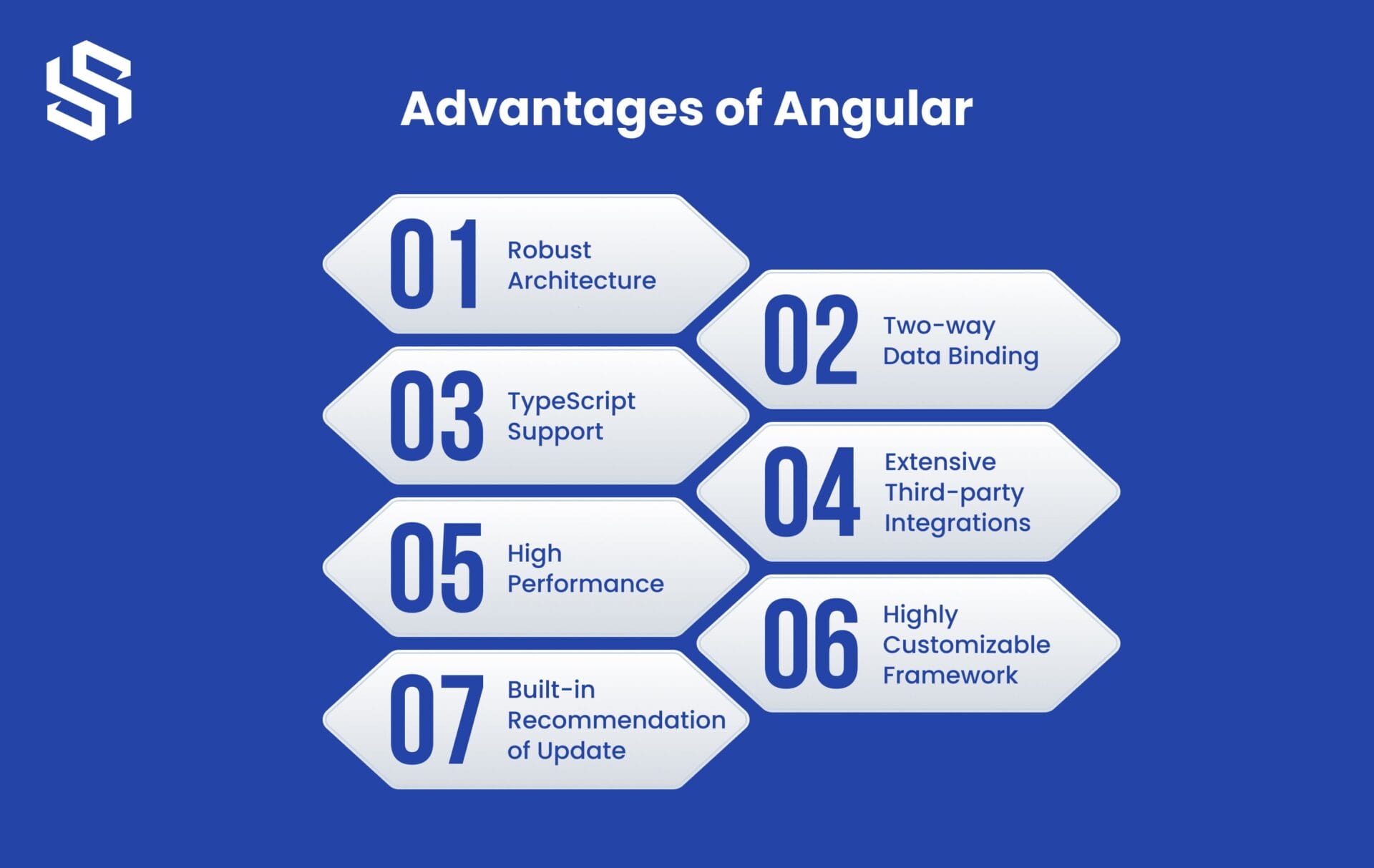
1. Robust Architecture
Building large-scale apps is made easy using Angular’s scalable and reliable architecture. It’s component-based structure and modular architecture encourage code reuse, which makes it simpler to manage and maintain complicated projects.
2. Two-Way Data Binding
The synchronization of data between the model and view of the application is made simpler by Angular’s strong two-way data binding. The view automatically updates whenever the model does, and vice versa, shortening the development cycle and increasing productivity.
3. TypeScript Support
A statically typed superset of JavaScript called TypeScript is used to create Angular. Better maintainability, code quality, and developer productivity are all facilitated by TypeScript’s improved tools, static type checking, and improved code structure.
4. Extensive Third-party Integrations
Developers may use various tools and frameworks since Angular makes it easy to integrate third-party apps. By giving developers access to a rich ecosystem of resources, this flexibility facilitates the inclusion of specific functionality and improves the development process.
5. High Performance
Angular ensures high performance for developers through various optimizations. The hierarchical dependency injection helps manage dependencies efficiently, while the Ivy renderer improves rendering speed. The AOT (Ahead-of-Time) compiler reduces load times, and differential loading optimizes bundle sizes. Angular Universal support enables server-side rendering for improved performance.
6. Highly Customizable Framework
With the many customization possibilities provided by Angular, developers may incorporate components and modules from other frameworks. Because of this compatibility, it is possible to use already-developed solutions and modify them to fit particular project needs. Further strengthening the framework’s adaptability and customizability is Angular’s support for encapsulating Angular HTML components as DOM elements, which makes it simple to reuse and maintain.
7. Built-in Recommendation of Update
The Angular command-line interface (CLI) offers helpful suggestions for updating dependencies, loaders, and plugins. It provides instructions on version compatibility, security updates, and best practices to help developers maintain a clean, safe codebase.
Vue.js – Where innovation meets user experience!
today to see what Vue can do for you.
Disadvantages of Angular

1. Upgrade Complexity
It can be difficult and time-consuming to upgrade Angular between major versions, necessitating substantial changes to existing codebases. Large projects based on earlier versions have difficulties as a result, including compatibility concerns, code rewrite, and API and convention adoption.
2. Maintenance Effort
Due to its extensive nature and higher code size, Angular requires more maintenance work. It becomes essential to stay current with versions, security updates, and best practices. In comparison to lighter frameworks, maintaining and debugging a bigger codebase takes more time and resources.
3. Over-Engineering Tendency
Especially with small projects, Angular’s flexibility and availability of options might result in over-engineering. Developers could be tempted to include unnecessary features, which would result in bloated code, complex abstractions, and more dependencies, making the project complex and challenging to manage.
Advantages of Vue
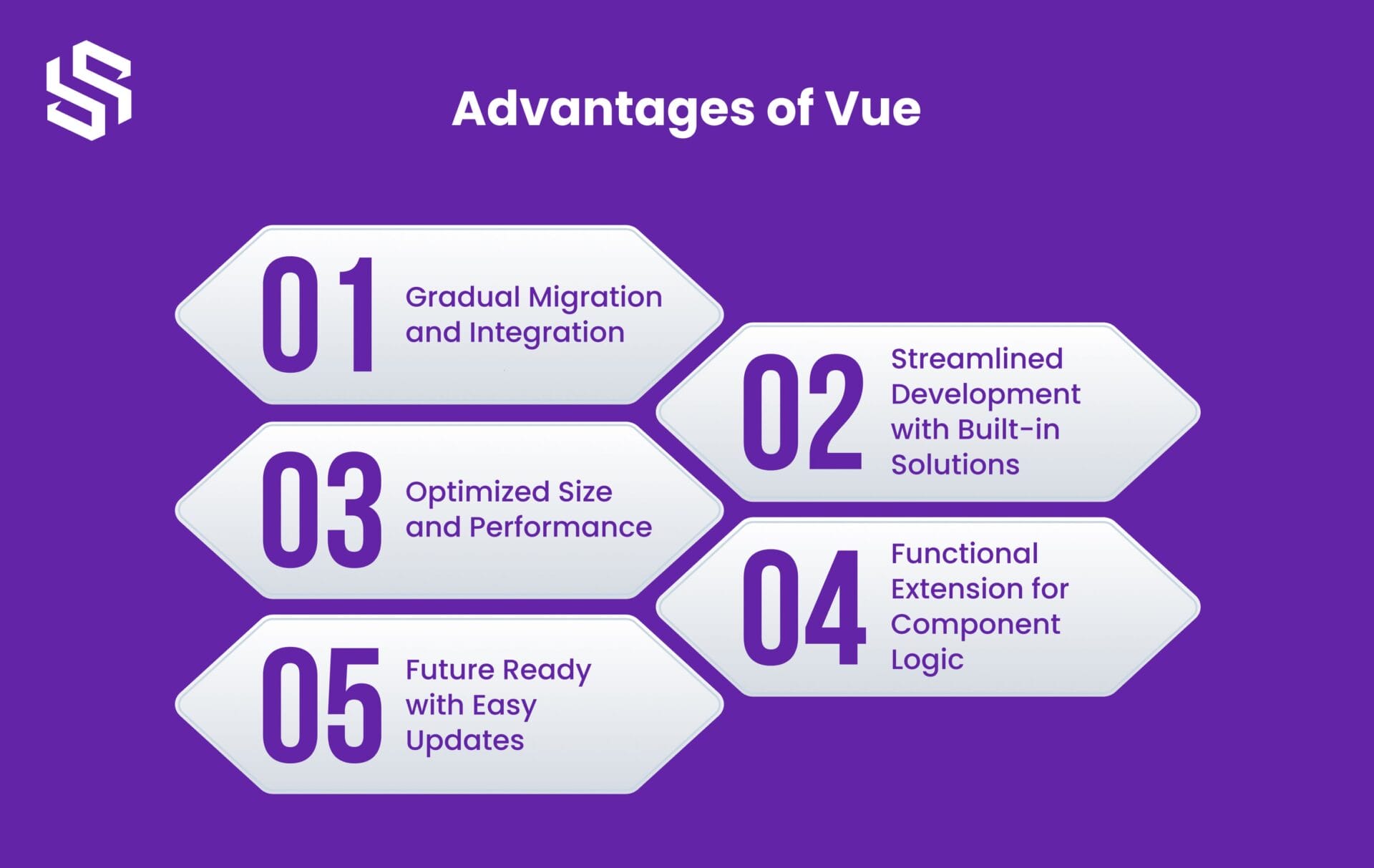
1. Gradual Migration and Integration
With Vue, the framework can be gradually integrated into existing codebases, easing the migration or integration process without necessitating a sizable up-front development time commitment.
2. Streamlined Development with Built-in Solutions
Vue eliminates the need to write repeated boilerplate code by providing built-in solutions for basic tasks like state management and component animations. This expedites the creation of applications and frees up developers to work on adding features.
3. Optimized Size and Performance
Every new release of Vue focuses on improving the framework’s size and speed, making it gradually lighter and quicker. By spending less time on debugging, code modification and more time on introducing new features, developers may profit from increased productivity
4. Functional Extension for Component Logic
Vue offers function-based additive API features, allowing for the flexible and extensive composition of component logic. This enables the creation of more readable and feature-rich components, enhancing code reusability and maintainability.
5. Future Ready with Easy Updates
Because of its robust production environment, Vue requires fewer upgrades and bug patches. The framework makes it simpler to update software and use the most recent revisions and enhancements. Developers cannot worry about old features or compatibility problems and can focus on creating apps.
Disadvantages of Vue
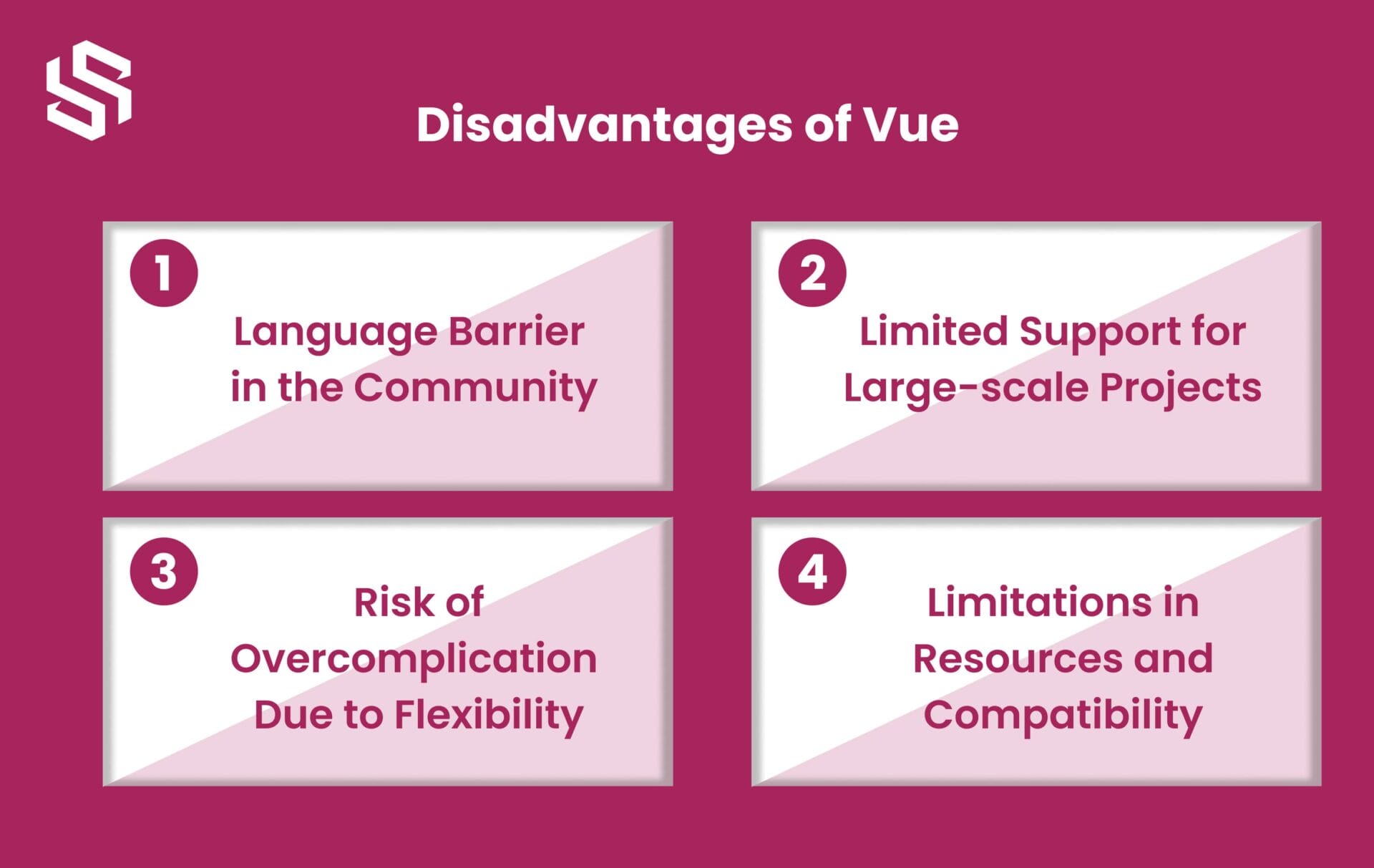
1. Language Barrier in the Community
Most of Vue’s community is Chinese-speaking, which might provide a linguistic barrier for English-speaking developers. Discussions, resources, and documentation are frequently conducted in Chinese, making it difficult for English-speaking developers to acquire and access essential information.
2. Limited Support for Large-scale Projects
As a relatively new framework, Vue may suffer issues when used for large-scale applications. The smaller size of its community and the presence of less-experienced developers might make resolving difficulties with complicated, large-scale apps more complex.
3. Risk of Overcomplication Due to Flexibility
While flexibility and customization options are valuable, Vue’s extensive flexibility can sometimes lead to over-complication. With numerous options available, projects can become more error-prone and suffer from code irregularities, particularly if developers misuse or misunderstand the available choices.
4. Limitations in Resources and Compatibility
Despite having a wide ecosystem, Vue may still lack plugins and tools that are commonly compatible with external sources and other frameworks. Additionally, it may have limited support for widely available resources, which can pose challenges when integrating Vue with existing tooling or leveraging external resources.
Front-end vs Back-end vs Full-stack Web Development
Angular vs Vue: Use cases
Popular JavaScript frameworks Angular and Vue provide multiple approaches for web development. When selecting the best framework for your project, being aware of the various use cases for each one will help you make an informed choice.
Angular Use Cases
- Large-scale Enterprise Applications
- Single-Page Applications
- Gaming applications
- Progressive Web Applications
- Real-time Applications
- Cloud-based applications
- Data-intensive Applications
- eCommerce applications
- Content Management Systems
Vue Use Cases
- Single-Page Applications (SPAs)
- Small to Medium-sized Applications
- Progressive Web Applications (PWAs)
- Integrating with Existing Projects
Most Popular Applications Built with Angular and Vue
A number of web applications have been developed using the popular JavaScript frameworks Angular and Vue.js. Numerous profitable applications have been made possible by their adaptability, efficiency, and developer-friendly characteristics. An overview of some of the most well-known programs created with Angular and Vue.js is provided below:
Popular Applications Built with Angular
1. Gmail
Angular powers the front end of Gmail, Google’s popular email service. It demonstrates Angular’s capability to handle complex user interfaces and provide a smooth user experience.
2. Microsoft Office Online
The web-based versions of Microsoft Office applications like Word, Excel, and PowerPoint are made rich and interactive by the widespread usage of Angular in Microsoft Office Online.
3. Forbes
Forbes, a well-known media company, offers a dynamic and interesting user experience across various platforms thanks to its usage of Angular as its content management system (CMS).
4. Upwork
Leading freelance marketplace Upwork uses Angular to build its user-friendly and feature-rich user interface, facilitating smooth cooperation between customers and freelancers.
5. NBA.com
The National Basketball Association’s (NBA) main website uses Angular to provide basketball fans worldwide with real-time scores, stats, news updates, and interactive features.
Need experts who understand Angular.js intricately?
Our developers bring their A-game to the table, ensuring your project’s success.
Don’t settle for less. Choose excellence –
.
Popular Applications Built with Vue
1. Alibaba
Alibaba, one of the biggest e-commerce enterprises in the world, uses Vue extensively. Vue’s flexibility and performance contribute to building a fast and user-friendly shopping experience on Alibaba’s platforms.
2. Xiaomi
The Xiaomi website, which showcases Xiaomi’s range of products and services, is built using Vue. Vue’s reactive data binding and component-based structure help create a responsive and visually appealing user interface.
3. Laravel Nova
Laravel Nova, a powerful administration panel for Laravel applications, utilizes Vue for its dynamic and interactive interface. Vue’s reactivity enhances the user experience in managing and configuring Laravel applications.
4. Trustpilot
Trustpilot, a popular online review platform, employs Vue for its user interface components. Vue’s simplicity and ease of integration allow Trustpilot to provide a seamless review experience for users.
5. EuroNews
A leading international news channel, EuroNews utilizes Vue.js in its web application, providing users with real-time news updates and an intuitive user interface.
VueJS vs Angular: Key Differences
Here’s a comparison table highlighting the key differences between VueJS and Angular:
| Aspect | VueJS | Angular |
|---|---|---|
| Learning Curve | Gentle learning curve | Steeper learning curve |
| Size | Lightweight | Heavier framework |
| Performance | Fast rendering | Efficient change detection |
| Flexibility | More flexible | Opinionated and structured |
| Community Support | Large and growing | Vast and well-established |
| Ecosystem | Smaller ecosystem | Comprehensive ecosystem |
| Scalability | Suitable for small to medium projects | Ideal for large-scale projects |
| Templating | HTML-based | Template language (Angular HTML) |
| Data Binding | Two-way binding | One-way data flow (with exceptions) |
| Development Speed | Quick prototyping | Longer setup and configuration |
| Mobile Development | NativeScript, Weex | Ionic Framework, NativeScript |
| Maintenance | Less opinionated | Requires adherence to conventions |
| Popularity | Rapidly gaining popularity | Well-established and widely used |
JavaScript Framework Battle: Svelte vs Vue – Which Reigns Supreme
VueJS vs Angular: Key Similarities
Here’s a table highlighting the key similarities between VueJS and Angular:
| Aspect | Explanation |
|---|---|
| Component-based | Both VueJS and Angular follow a component-based architecture, allowing developers to build modular and reusable UI components. Components in both frameworks encapsulate their own logic and can be composed together to create complex applications. |
| Reactive Data Binding | VueJS and Angular both provide mechanisms for binding data to the user interface. VueJS uses two-way data binding, where changes in the UI update the data model and vice versa. Angular primarily uses one-way data flow with exceptions, enabling efficient change detection and enhancing performance. |
| Directives | Both frameworks offer directives as a way to extend HTML syntax and provide additional functionality. Directives in VueJS and Angular allow developers to manipulate the DOM, handle events, apply conditional rendering, and perform other tasks to enhance the user interface. |
| Large Community | Both VueJS and Angular have active and supportive communities. Developers can find a wealth of resources, tutorials, and libraries for both frameworks. The communities also contribute to the growth and improvement of the frameworks through discussions, bug reporting, and feature requests. |
| TypeScript Support | VueJS and Angular both have excellent support for TypeScript, a statically typed superset of JavaScript. Developers can leverage TypeScript’s features, such as strong typing and advanced tooling, to build more scalable and maintainable applications. |
| CLI Tools | Both frameworks provide command-line interface (CLI) tools that simplify project setup, development, and build processes. The CLI tools offer features like project scaffolding, code generation, testing, and deployment options, making development workflows more efficient. |
When to choose Vue over Angular?
- For smaller to medium-sized projects with less complicated specifications
- If you desire an easy onboarding process and a gradual learning curve
- When simplicity and adaptability are prized
- If you place a high priority on rapid prototyping and development
- When you want to create single-page apps or progressive web apps
- If you need a compact framework with quick rendering
When to choose Angular over Vue?
- For complicated needs in large-scale corporate applications
- If you favor a prescriptive and partisan framework
- When you want a large number of integrated features and a wide ecosystem
- If you appreciate solid community backing and a framework that is developed
- When you need reliable tools for developing, testing and scaling apps
- If you want to build native mobile apps or you want powerful animation and routing tools
Web Development Showdown: NodeJS vs Django – Which Reigns Supreme?
Conclusion
The project’s requirements, scope, and complexity will determine which framework we should use.
Syndell is an excellent company to work with if you’re looking for a trustworthy partner for AngularJS development. You may create scalable and secure web apps with the aid of our assortment of AngularJS development services. Our team of skilled developers can assist you in creating dependable and scalable programs that satisfy your company’s needs.
Contact us now if you’re looking to hire AngularJS developers or need AngularJS development services.
Also, Syndell can assist you in creating quick and effective web apps if you’re looking for a VueJS development company or want to Hire Vue JS developers. Our VueJS development services are tailored to meet your business requirements and deliver exceptional results.
Do you want to learn more and see how we can help you build fast and efficient web applications? Contact us at Syndell.