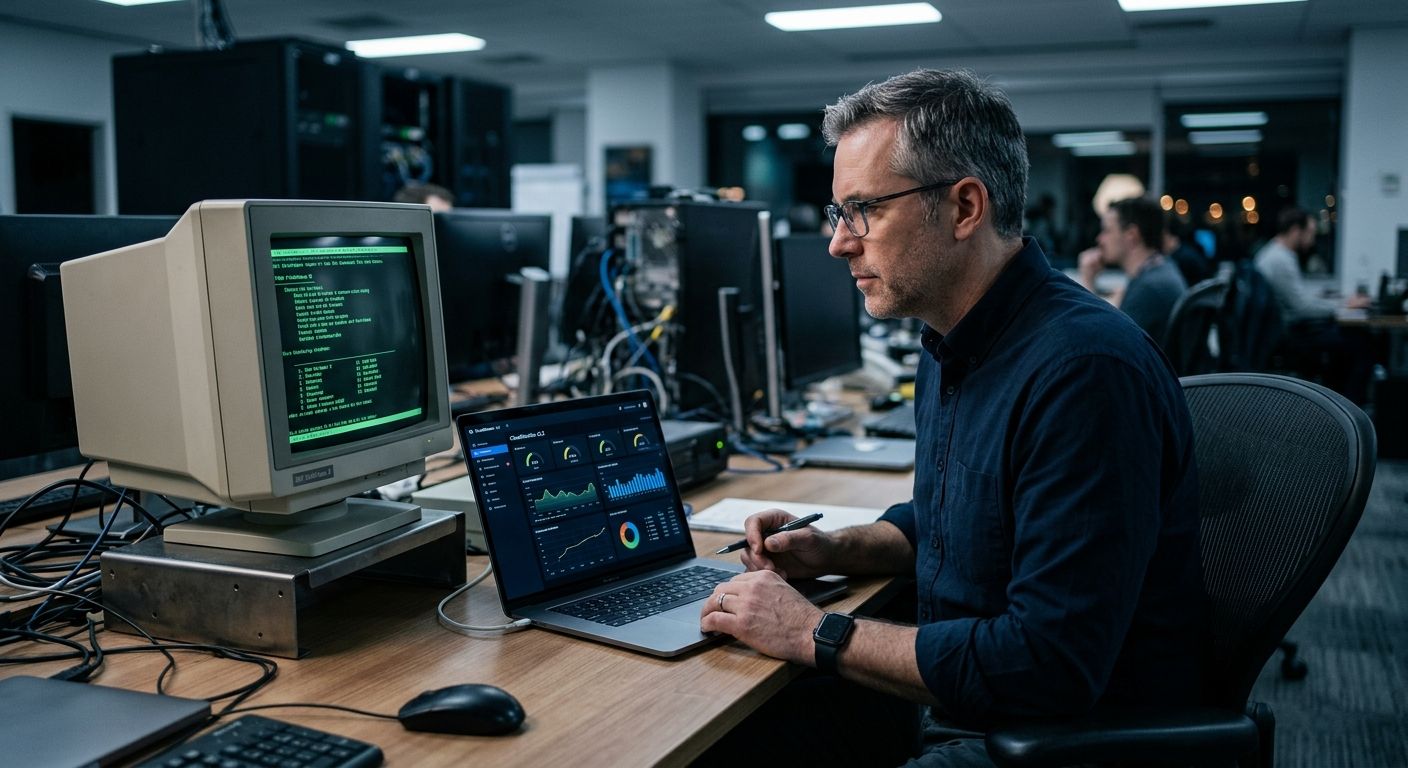
Modernizing a legacy business system costs $30,000 to $150,000 for a targeted refresh of one application, and $200,000 to $1,000,000 or more when an ERP, core platform or multi-system estate is rebuilt or migrated wholesale. The deciding factors are how much logic can be lifted as-is, how clean the data is, and whether the system keeps running during the move.
TL;DR
- A single-application modernization runs $30,000–$150,000; a full core-platform migration $200,000–$1,000,000+.
- Re-architecting for the cloud typically costs 30–50% of what a from-scratch rebuild would.
- Legacy hosting, security patching and downtime cost mid-size companies $100,000–$500,000 a year before the modernization budget even starts.
- Data migration and testing consume 25–40% of a realistic modernization budget.
- Incremental modernization (one module per quarter) spreads cost and keeps the business running; big-bang rewrites are where projects fail.
Cost by modernization approach
| Approach | What it means | Typical range |
|---|---|---|
| Rehosting (lift and shift) | Move the app to cloud infrastructure as-is | $20,000–$100,000 |
| Re-architecting | Break the monolith into services, new APIs, cloud-native patterns | $80,000–$400,000 |
| Rebuild | Rewrite the system from requirements, keeping the data model | $150,000–$800,000 |
| Replace | Buy a packaged product and migrate data to it | $100,000–$500,000 + licenses |
These figures assume a mid-size system (roughly 50–300 screens and 5–15 integrations). Larger estates scale roughly linearly with module count.
What drives the cost up or down
- Code and documentation quality. Undocumented business rules locked in a 15-year-old codebase have to be reverse-engineered screen by screen. That discovery work alone can add 20–40% before a line of new code ships.
- Data migration. Years of inconsistent records, duplicate customers and dead reference data have to be cleansed, mapped and validated. On realistic projects, data work plus regression testing takes 25–40% of the total budget.
- Integrations. Every connection to accounting, warehouse, CRM or payment systems has to be rebuilt and re-tested. Budget $8,000–$30,000 per production-grade integration.
- Downtime tolerance. Systems that can pause for a cutover weekend are far cheaper to move than systems that must run continuously — dual-running both environments during a phased migration adds 15–30%.
- Team model. US-based delivery bills $150–$250 per hour, offshore teams $30–$60. A blended model keeps product decisions onshore and the build offshore.
Do nothing is not the cheap option
Aging systems cost money even when they work: extended support contracts for end-of-life software, premium hosting for hardware that only runs legacy stacks, security exposure that compliance audits flag every year, and manual workarounds that grow every time the business changes. For a mid-size company this burden typically runs $100,000–$500,000 a year — which is why the payback math on a $400,000 modernization is often three years or less. The counter-question to ask before approving the budget is what the current system will cost to keep alive for that same three years.
Incremental beats big-bang
The projects that fail are the ones that stop the world for a rewrite. The ones that succeed modernize one module per quarter — new checkout flows first, then reporting, then the integration layer — proving value with each release while the old system keeps running. It costs marginally more in total (two systems run side by side for a while) but the risk profile is completely different, and each phase can be stopped without losing everything.
A cloud migration assessment should produce exactly this phased plan with a cost range per phase — if a vendor can only quote one big number, that is a red flag.
How much does it cost to migrate an ERP to the cloud?
A mid-size ERP migration (rehost or re-platform of a system like Dynamics, SAP Business One or a bespoke ERP) typically costs $150,000–$500,000 including data migration, integration rework and dual-run support. Enterprise SAP-class estates run into seven figures.
How long does a legacy modernization take?
Three to six months for a single application, 9–18 months for a core platform done incrementally. The phased approach stretches the calendar but de-risks every step.
Is it cheaper to modernize or rebuild from scratch?
Modernizing usually wins when business logic is sound and users know the workflows — you are paying to change the plumbing, not the product. Rebuilding wins when the system no longer matches how the business works. Syndell’s application maintenance team can audit which of the two your system actually needs before budget is committed.
One last thing
The budget line that kills modernization projects is not the build — it is the validation. Firms under-resource regression testing because the old system “already works”, then discover that the migration silently changed how purchase orders, payroll or fulfillment behave. Fund testing and data validation at 25–40% of the total and the project lands. Syndell’s guide to estimating custom software development cost covers how to structure that estimate line by line.
Get a phased modernization estimate
See the cost per phase before you commit to a migration.
Talk to Syndell