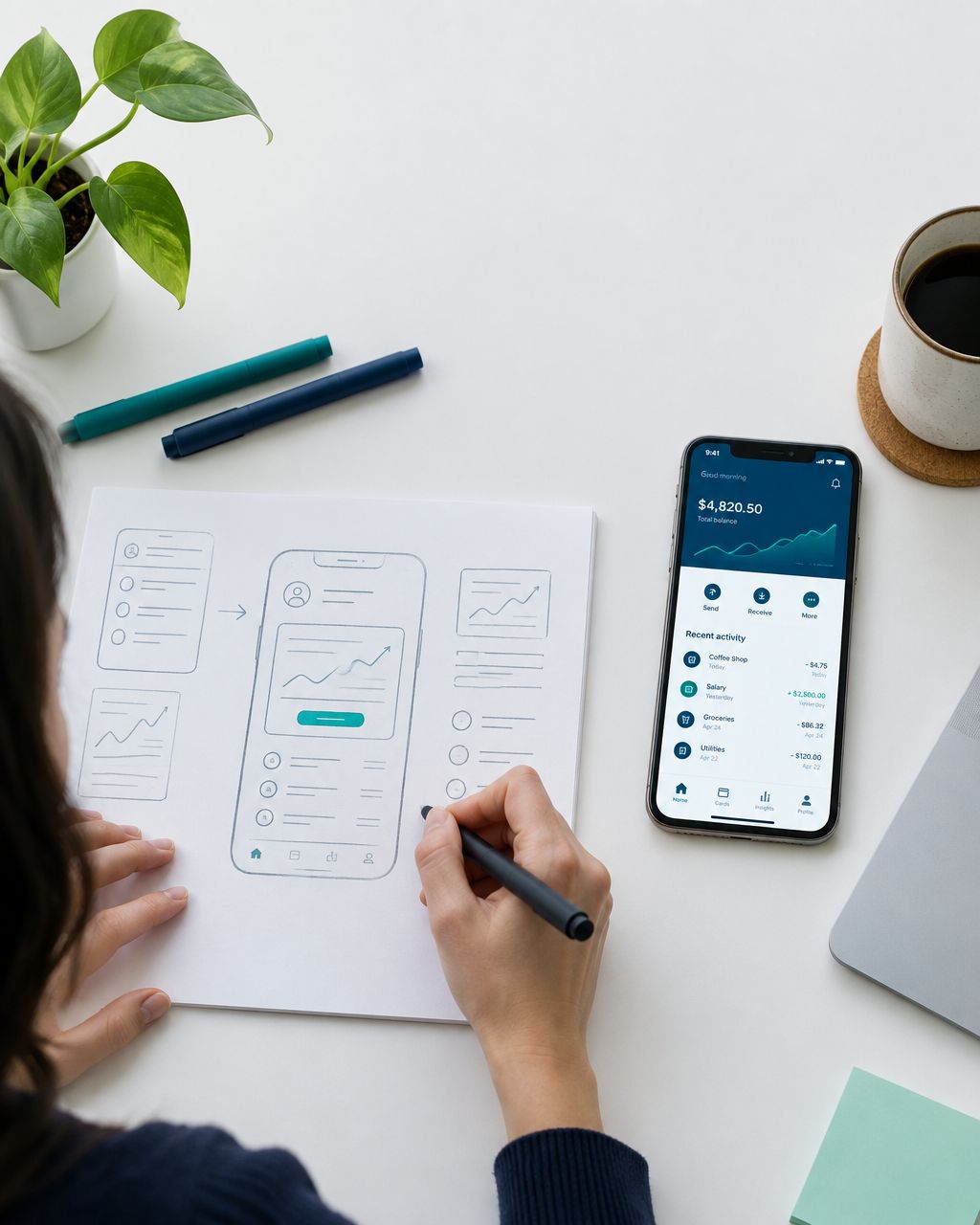
UI/UX design services for fintech apps are the research, interface design and usability engineering that turn a financial product into something customers trust enough to onboard, transact and return to. This guide is for founders, product managers and digital leaders buying that work: what fintech design must cover, how to run the buying process, and how to choose between in-house, freelance and agency options.
Why fintech UI/UX is different from ordinary app design
A fintech app asks users for their money, their identity documents and their trust — in that order. Three things follow. First, compliance is a design input: KYC verification, consent screens and transaction confirmations must be designed into the flows, not bolted on. Second, data density is high — balances, charts, transaction histories — so hierarchy and scannability decide usability. Third, error tolerance is unforgiving: a mis-tapped payment is far costlier than a mis-tapped like. A design partner that has shipped fintech software plans for all three from day one; a generalist agency usually discovers them mid-project.
How to buy UI/UX design services for a fintech app
Audit your current funnel first
Before briefing anyone, measure where users drop: install to signup, signup to KYC completion, KYC to first transaction. The manual way is a spreadsheet and screen recordings; an experienced partner does this in week one. Each drop-off point becomes a design objective, which is what you hold the design work accountable to.
- Export funnel numbers for the last full quarter
- Record five real user sessions, including failures
- List the three steps with the worst completion rates
Map regulatory flows before visual design
KYC, AML checks, consent and data-privacy screens vary by market. Sketch the required steps per market as a flow diagram before any pixels are drawn — redesigning a compliance flow after launch costs multiples of designing it correctly first.
- List the markets you serve and their verification requirements
- Mark every screen where regulation dictates content
- Agree the error and retry paths for failed verifications
Design for data density and error recovery
Fintech screens carry more information than almost any consumer app. Insist on wireframes that show a realistic worst case — a busy transaction history, a partial KYC state — not a happy-path demo with three rows of data. Every destructive action needs an undo path and a clear confirmation pattern.
Prototype with realistic data
Approve clickable prototypes filled with plausible accounts, failed states and edge cases. This is where design partners earn their fee: it surfaces confusing language and dead ends while changes are cheap.
Test with real users and real money moments
Run moderated tests on the flows that move money — deposits, transfers, withdrawals. Five to eight users per round catches the majority of usability blockers in these flows, and two rounds beat one large one.
Demand a design system, not just screens
A component library with documented states — inputs, errors, loading, empty — is what keeps v2 and v3 consistent when your team or your partner changes. Make it a deliverable in the contract, not a nice-to-have.
Your options for fintech UI/UX design, compared
| Option | Best for | Key limitation |
|---|---|---|
| In-house designer | Long-term products with steady design needs | One person rarely covers research, UI and design systems |
| Freelance specialists | Tight budgets, single-surface work | Continuity and compliance depth vary widely |
| Specialist fintech design agency | Complex regulated products, replatforms | Higher cost; design often detached from build |
| Full-cycle product partner (Syndell) | Teams that want design and engineering together | Requires committing to a dedicated team model |
If your app also leans on intelligent features — personalization, spending insights, conversational support — a partner that designs and builds AI and ML capabilities avoids the handoff friction between a design-only agency and a separate engineering vendor.
Common mistakes fintech teams make
- Treating compliance screens as legal's problem and handing them to design last
- Copying consumer-social patterns onto money-movement flows
- Shipping screens without error, loading and empty states designed
- Buying a fixed set of screens with no design system, then paying to redo v2
Planning a fintech app or redesign?
Get design and engineering from one senior team — funnel audit included in your first call.
Talk to Syndell