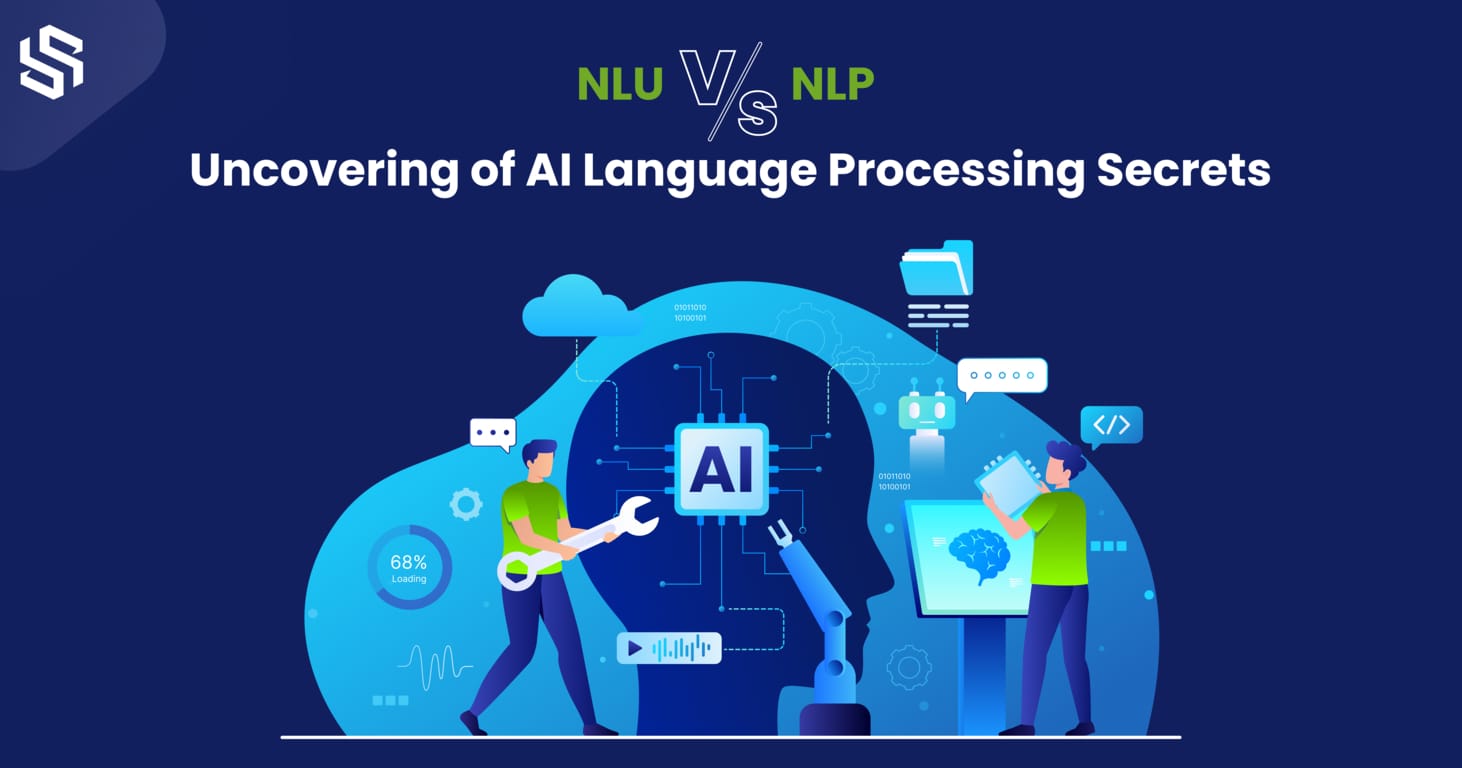
In the realm of language processing in AI, two fundamental components hold the key to unlocking its secrets: Natural Language Understanding (NLU) and Natural Language Processing (NLP).
Consider a scenario in which a group of interns is methodically processing a large volume of sensitive documents within an insurance business, law firm, or hospital. Their critical role is to process these documents correctly, ensuring that no sensitive information is accidentally shared. However, the threat of unintended errors remains.
Imagine if they had at their disposal a remarkable language robot known as “NLP”—a powerful creature capable of automatically redacting personally identifiable information while maintaining the confidentiality of sensitive data. NLP, with its ability to identify and manipulate the structure of language, is indeed a powerful tool.
However, it needs NLU—a subset of NLP—to truly comprehend the meaning behind words. By incorporating NLU into their document processing workflow, the interns can significantly enhance the accuracy of their retrievals. No longer do they need to worry about the dire consequences of leaking confidential information, unless, of course, they accidentally spill coffee on the robot’s control panel!
The global market for NLP is projected to reach a staggering USD 127.26 billion by 2028, underscoring the importance of understanding the nuanced differences between NLU and NLP.
In this article, we will take a deep dive into the fascinating world of NLU and NLP, examining their definitions, principles, crucial distinctions and how nlp works in chatbot, also delve into more details about what is the role of natural language understanding in NLP. Join us as we unravel the mysteries and unlock the true potential of language processing in AI.
Furthermore, based on specific use cases, we will investigate the scenarios in which favoring one skill over the other becomes more profitable for organizations. This research will provide you with the insights you need to determine which AI solutions are most suited to your organization’s specific needs.
How the Top Business Challenges Can be Solved by Generative AI Tools like ChatGPT
Looking to take your web application to the next level?
Consider leveraging our Node.js development services to optimize its performance and scalability.
Exploring the Dynamics of Language Processing in AI
Our brains work hard to understand speech and written text, helping us make sense of the world. But our understanding is limited to what we already know. Machine learning is a way to interpret information and gain knowledge.
To explore the exciting possibilities of AI and Machine Learning based on language, it’s important to grasp the basics of Natural Language Processing (NLP). It’s like taking the first step into a whole new world of language-based technology.
What is Natural Language Processing (NLP)?
NLP full form is Natural Language Processing (NLP) is an exciting field that focuses on enabling computers to understand and interact with human language. It involves the development of algorithms and techniques that allow machines to read, interpret, and respond to text or speech in a way that resembles human comprehension.
One of the primary goals of NLP is to bridge the gap between human communication and computer understanding. By analyzing the structure and meaning of language, NLP aims to teach machines to process and interpret natural language in a way that captures its nuances and complexities.
This involves breaking down sentences, identifying grammatical structures, recognizing entities and relationships, and extracting meaningful information from text or speech data. NLP algorithms use statistical models, machine learning, and linguistic rules to analyze and understand human language patterns.
The applications of NLP are vast and diverse. From chatbots and virtual assistants that can engage in conversations with users, to machine translation systems that can convert text from one language to another, NLP plays a crucial role in enabling effective communication between humans and machines.
It also facilitates sentiment analysis, which involves determining the sentiment or emotion expressed in a piece of text, and information retrieval, where machines retrieve relevant information based on user queries. NLP has the potential to revolutionize industries such as healthcare, customer service, information retrieval, and language education, among others.
What is Natural Language Understanding (NLU)?

NLU full form is Natural Language Understanding (NLU) is a crucial subset of Natural Language Processing (NLP) that focuses on teaching machines to comprehend and interpret human language in a meaningful way. Natural Language Understanding in AI goes beyond simply recognizing and processing text or speech; it aims to understand the meaning behind the words and extract the intended message.
The main objective of NLU is to enable machines to grasp the nuances of human language, including context, semantics, and intent. It involves various tasks such as entity recognition, named entity recognition, sentiment analysis, and language classification. NLU algorithms leverage techniques like semantic analysis, syntactic parsing, and machine learning to extract relevant information from text or speech data and infer the underlying meaning.
The applications of NLU are diverse and impactful. By understanding human language, NLU enables machines to provide personalized and context-aware responses in chatbots and virtual assistants. It plays a crucial role in information retrieval systems, allowing machines to accurately retrieve relevant information based on user queries.
NLU is also utilized in sentiment analysis to gauge customer opinions, feedback, and emotions from text data. Additionally, it facilitates language understanding in voice-controlled devices, making them more intuitive and user-friendly. NLU is at the forefront of advancements in AI and has the potential to revolutionize areas such as customer service, personal assistants, content analysis, and more.
Are you considering the implementation of an AI/ML-based software solution?
Our team of experienced developers is here to help bring your vision to life.
Reach out to us now and let’s discuss how we can drive your business forward with cutting-edge technology.
A Closer Look At How Language Technologies Work
Knowing how these technologies work allows us to grasp their capabilities and limits and use them to their maximum potential. And, of course, to comprehend how they differ!
How Does Natural Language Processing Work?
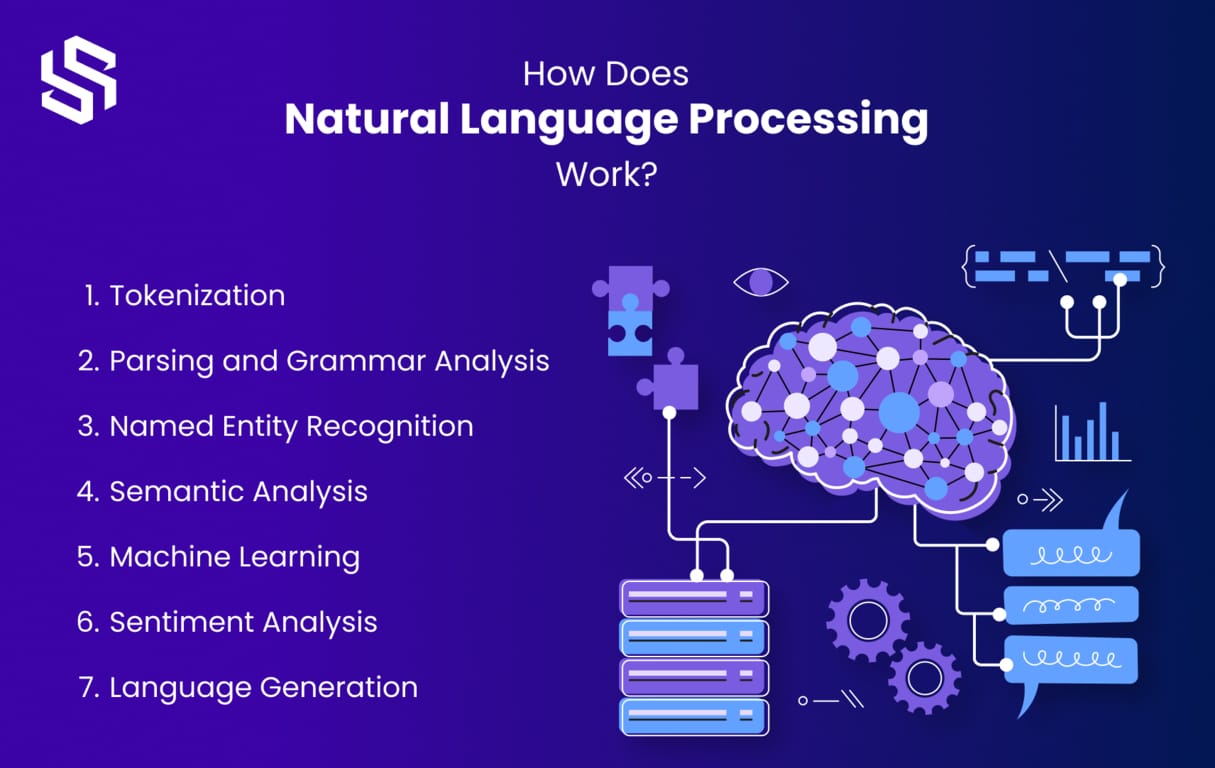
Natural Language Processing (NLP) encompasses a series of steps and techniques that enable machines to understand and process human language. Here’s an overview of how NLP works:
1. Tokenization
Language processing begins with tokenization, which breaks the input into smaller pieces. Tokens can be words, characters, or subwords, depending on the tokenization technique. Tokenization simplifies language processing and analysis.
Tokenization helps NLP tasks including text classification, language modeling, and machine translation. After tokenizing the input, analysis can focus on meaning and relationships.
“I love eating ice cream” would be tokenized into [“I”, “love”, “eating”, “ice”, “cream”]. Each word becomes a token, enabling better analysis and interpretation.
Complex languages with compound words or agglutinative structures benefit from tokenization. By splitting text into smaller parts, following processing steps can treat each token separately, collecting valuable information and patterns.
Tokenization helps with punctuation, special characters, and numbers. These elements are tokenized to avoid analytical errors.
2. Parsing and Grammar Analysis
Parsing and grammatical analysis help NLP grasp text structure and relationships. Parsing establishes sentence hierarchy, while part-of-speech tagging categorizes words.
Part-of-speech Tags classify words as nouns, verbs, or adjectives. This method determines a sentence’s word function. Parsing analyzes word associations to reveal sentence structure. It establishes syntactic hierarchy and shows word relationships.
Constituency parsing combines words into phrases, while dependency parsing shows grammatical dependencies. NLP systems extract subject-verb-object relationships and noun phrases using parsing and grammatical analysis.
NLP systems learn language syntax through part-of-speech tagging and parsing. Accurate language processing aids information extraction and sentiment analysis. Grammar helps NLP systems understand and interpret language.
3. Named Entity Recognition (NER)
Named Entity Recognition (NER) is an important NLP activity that identifies and classifies named entities in text. Named entities include persons, organizations, locations, dates, quantities, and more. NER helps extract important data and interpret text context.
NER systems scan input text and detect named entity words and phrases using various algorithms. In the statement “Apple Inc. is headquartered in Cupertino,” NER recognizes “Apple Inc.” as an entity and “Cupertino” as a location.
NER uses contextual information, language patterns, and machine learning algorithms to improve entity recognition accuracy beyond keyword matching. NER systems are trained on vast datasets of named items in multiple contexts to identify similar entities in new text.
Information retrieval, question-answering systems, sentiment analysis, and text summarization utilise NER-extracted data. NER improves text comprehension and information analysis by detecting and classifying named things.
4. Semantic Analysis
Natural Language Processing (NLP) relies on semantic analysis to decipher text. It involves exercises that reveal a sentence’s semantic links and roles.
Semantic role labeling is significant in semantic analysis. It identifies sentence entities and their roles. In the sentence “John eats an apple,” semantic role labeling would identify “John” as the agent (eater) and “apple” as the patient (eaten).
Semantic analysis seeks the text’s deeper meaning and intentions. Understanding semantics requires context, inference, and word relationships.
NLP systems can extract subject-verb-object relationships, verb semantics, and text meaning from semantic analysis. Information extraction, question-answering, and sentiment analysis require this data.
5. Machine Learning
Machine learning techniques help NLP systems interpret and process language. NLP models find patterns, predict, and perform language processing tasks utilizing large datasets.
NLP models can learn language recognition and interpretation from examples and data using machine learning. These models are trained on varied datasets with many language traits and patterns. Models optimize their algorithms and parameters throughout training.
Machine learning optimizes and fine-tunes NLP models. After training, models can be adjusted using specific datasets or methods to improve accuracy and efficacy. Fine-tuning exposes the model to domain-specific or task-specific data to improve performance on certain applications or use cases.
NLP machine learning improves and adapts through iteration. More data and real-world natural language processing in ai examples help models learn language and improve performance.
Top Applications of NLP Across Industries: A Comprehensive Guide
6. Sentiment Analysis
Sentiment analysis is a useful NLP application that analyzes text sentiment. It lets systems analyze text or consumer comments for sentiment.
NLP models can determine text sentiment—positive, negative, or neutral—using several methods. This analysis helps analyze public opinion, client feedback, social media sentiments, and other textual communication.
Sentiment analysis is multi-step. Preprocessing includes noise removal, tokenization, and word normalization. Next, the sentiment analysis model labels each sentence or paragraph based on its sentiment polarity.
Different models can analyze sentiment. Rule-based sentiment labeling uses patterns and rules. Machine learning algorithms learn sentiment patterns from labeled data.
Customer feedback, brand monitoring, market research, and social media analytics use sentiment analysis. It reveals public opinion, customer satisfaction, and sentiment toward products, services, or issues.
7. Language Generation
NLP systems generate human-like language through language generation. This allows computers to summarize content, translate, and respond to chatbots.
Summarizing a text retains vital information while shortening it. NLP models evaluate the text, extract key information, and create a summary.
Text is translated automatically by machine. NLP models learn language semantics and syntax from massive bilingual data. They then translate content that retains meaning and context.
NLP also generates chatbot responses. NLP models help chatbots understand user input and respond conversationally. The models examine context, previous messages, and user intent to provide logical, contextually relevant replies.
Language generation uses neural networks, deep learning architectures, and language models. Large datasets train these models to generate coherent, fluent, and contextually appropriate language.
Language generation is used for automated content, personalized suggestions, virtual assistants, and more. Systems can improve user experience and communication by using NLP’s language generation.
By combining linguistic rules, statistical models, and machine learning techniques, NLP enables machines to process, understand, and generate human language. This technology has applications in various fields such as customer service, information retrieval, language translation, and more.
How Does Natural Language Understanding Work?
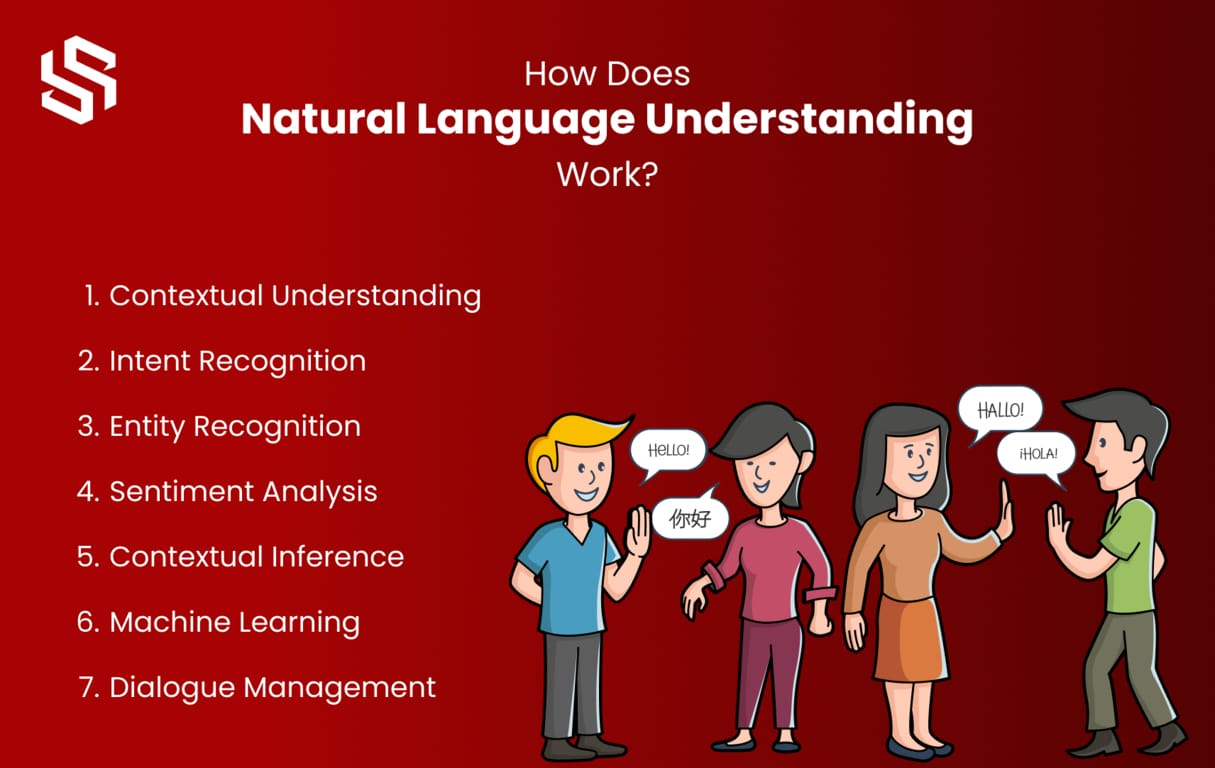
Natural Language Understanding (NLU) is a subset of Natural Language Processing (NLP) that focuses on teaching machines to comprehend and interpret human language. Here’s an overview of how NLU works:
1. Contextual Understanding
Natural Language Understanding in AI aims to understand the context in which language is used. It considers the surrounding words, phrases, and sentences to derive meaning and interpret the intended message.
2. Intent Recognition
NLU seeks to identify the underlying intent or purpose behind a given piece of text or speech. It classifies the user’s intention, whether it is a request for information, a command, a question, or an expression of sentiment.
3. Entity Recognition
NLU recognizes and categorizes entities mentioned in the text, such as people, places, organizations, dates, and more. It helps extract relevant information and understand the relationships between different entities.
4. Sentiment Analysis
NLU can analyze the sentiment or emotion expressed in text, determining whether the sentiment is positive, negative, or neutral. This helps in understanding the overall sentiment or opinion conveyed in the text.
5. Contextual Inference
NLU goes beyond literal interpretation and involves understanding implicit information and drawing inferences. It takes into account the broader context and prior knowledge to comprehend the meaning behind the ambiguous or indirect language.
6. Machine Learning
NLU leverages machine learning algorithms to train models on labeled datasets. These models learn patterns and associations between words and their meanings, enabling accurate understanding and interpretation of human language.
7. Dialogue Management
NLU plays a crucial role in dialogue management systems, where it understands and interprets user input, allowing the system to generate appropriate responses or take relevant actions.
By combining contextual understanding, intent recognition, entity recognition, and sentiment analysis, NLU enables machines to comprehend and interpret human language in a meaningful way. This understanding opens up possibilities for various applications, such as virtual assistants, chatbots, and intelligent customer service systems.
If you’re interested in creating an AI or ML-based software solution, get in touch with us today to receive a quote from our team of experienced developers
What is NLG? Why is it an essential component of NLP?
Natural Language Generation (NLG) is an essential component of Natural Language Processing (NLP) that complements the capabilities of natural language understanding. While NLU focuses on interpreting human language, NLG takes structured and unstructured data and generates human-like language in response.
By harnessing advanced algorithms, NLG systems transform data into coherent and contextually relevant text or speech. These algorithms consider factors such as grammar, syntax, and style to produce language that resembles human-generated content.
The integration of NLU and NLG enhances the overall effectiveness of NLP. NLU enables machines to understand and interpret human language, while NLG allows machines to communicate back in a way that is more natural and user-friendly.
Through the combination of these two components of NLP, it provides a comprehensive solution for language processing. It enables machines to understand, generate, and interact with human language, opening up possibilities for applications such as chatbots, virtual assistants, automated report generation, and more.
The algorithms utilized in NLG play a vital role in ensuring the generation of coherent and meaningful language. They analyze the underlying data, determine the appropriate structure and flow of the text, select suitable words and phrases, and maintain consistency throughout the generated content.
The Future of Digital Marketing: AI Challenges to Keep an Eye on in 2023
Key Difference between NLP and NLU in AI
Here’s a table summarizing the key differences between Natural Language Processing (NLP) and Natural Language Understanding (NLU):
| Aspect | Natural Language Processing (NLP) | Natural Language Understanding (NLU) |
|---|---|---|
| Objective | Processing and manipulation of human language by machines | Understanding the meaning and intent behind human language |
| Scope | Deals with language structure, form, and statistical patterns | Focuses on semantic understanding, context, and intentions of language |
| Tasks | Tokenization, part-of-speech tagging, syntactic parsing, machine translation, etc. | Entity recognition, intent recognition, sentiment analysis, contextual understanding, etc. |
| Emphasis | Structural aspects of language | Semantic understanding and contextual interpretation of language |
| Focus | Language processing and generation | Meaning extraction and comprehension of language |
| Applications | Machine translation, text summarization, sentiment analysis, etc. | Chatbots, virtual assistants, voice assistants, customer support systems, etc. |
| Key Techniques | Statistical models, language rules, pattern recognition | Machine learning, semantic analysis, contextual understanding |
| Outcome | Manipulation, analysis, and generation of human-like language | Comprehension and interpretation of human language |
Difference between NLU vs NLP applications
Here’s a comparison table highlighting the applications of Natural Language Understanding (NLU) and Natural Language Processing (NLP) technologies:
| Application | Natural Language Understanding (NLU) | Natural Language Processing (NLP) |
|---|---|---|
| Chatbots | Enables chatbots to understand user intents, respond contextually, and provide assistance | Processes user inputs, analyzes language structure, and generates appropriate responses |
| Voice Assistants | Interprets voice commands, understands user queries, and performs actions accordingly | Converts spoken language into text, processes and analyzes the textual input |
| Sentiment Analysis | Identifies and analyzes sentiments expressed in text, helping gauge opinions and emotions | Extracts sentiment from text, classifies it as positive, negative, or neutral |
| Language Translation | Translates text or speech from one language to another, preserving meaning and context | Converts text or speech from one language to another, focusing on linguistic accuracy |
| Information Extraction | Extracts specific information or entities from text, such as names, dates, or locations | Processes and extracts relevant information from unstructured text data |
| Text Summarization | Generates concise summaries of longer texts, capturing key information | Analyzes and condenses text to provide a concise summary |
| Question Answering | Understands questions and provides relevant answers or information | Analyzes and processes questions to generate accurate responses |
| Virtual Assistants | Powers intelligent virtual assistants by understanding natural language commands | Supports natural language interactions, enabling virtual assistants to perform tasks |
Difference between NLU vs NLP Use Cases
Here’s a comparison table showcasing some common use cases for both Natural Language Understanding (NLU) and Natural Language Processing (NLP) technologies:
| Use Case | Natural Language Understanding (NLU) | Natural Language Processing (NLP) |
|---|---|---|
| Chatbot Interaction | Understands user intents, provides contextually relevant responses | Processes user inputs, generates appropriate responses based on language rules |
| Sentiment Analysis | Analyzes and determines sentiment or emotions expressed in text | Extracts sentiment from text, classifies it as positive, negative, or neutral |
| Language Translation | Translates text or speech from one language to another | Converts text or speech from one language to another, focusing on linguistic accuracy |
| Voice Assistants | Interprets voice commands, responds contextually | Converts spoken language into text, processes and analyzes the textual input |
| Entity Recognition | Identifies and categorizes entities (names, locations, dates, etc.) in text | Extracts and classifies specific entities mentioned in unstructured text |
| Text Summarization | Generates concise summaries of longer texts | Analyzes and condenses text to provide a brief summary |
| Question Answering | Understands questions and provides relevant answers or information | Processes questions to generate accurate responses |
| Intent Classification | Classifies user intents in natural language interactions | Analyzes and categorizes user intents for appropriate system response |
| Named Entity Recognition | Identifies and extracts named entities, such as names, organizations, etc. | Detects and extracts specific entities mentioned in unstructured text |
| Customer Support Automation | Understands customer queries, provides relevant solutions or assistance | Analyzes customer inquiries and generates appropriate responses |
List of Top Data Science Platforms for 2023
What happens When NLP and NLU work together?
The collaboration between Natural Language Processing (NLP) and Natural Language Understanding (NLU) is a powerful force in the realm of language processing and artificial intelligence. By working together, NLP and NLU enhance each other’s capabilities, leading to more advanced and comprehensive language-based solutions.
NLP, with its focus on language structure and statistical patterns, enables machines to analyze, manipulate, and generate human language. It provides the foundation for tasks such as text tokenization, part-of-speech tagging, syntactic parsing, and machine translation. NLP algorithms excel at processing and understanding the form and structure of language.
On the other hand, NLU delves deeper into the semantic understanding and contextual interpretation of language. It goes beyond the structural aspects and aims to comprehend the meaning, intent, and nuances behind human communication. NLU tasks involve entity recognition, intent recognition, sentiment analysis, and contextual understanding. By leveraging machine learning and semantic analysis techniques, NLU enables machines to grasp the intricacies of human language.
When NLP and NLU work in harmony, their synergy unlocks new possibilities. NLP provides the foundation for NLU by extracting structural information from text or speech, while NLU enriches NLP by inferring meaning, context, and intentions. This collaboration enables machines to not only process and generate human-like language but also understand and respond intelligently to user inputs.
The combination of NLP and NLU has revolutionized various applications, such as chatbots, voice assistants, sentiment analysis systems, and automated language translation. Chatbots powered by NLP and NLU can understand user intents, respond contextually, and provide personalized assistance.
Voice assistants equipped with these technologies can interpret voice commands and provide accurate and relevant responses. Sentiment analysis systems benefit from NLU’s ability to extract emotions and sentiments expressed in text, leading to more accurate sentiment classification.
The power of collaboration between NLP and NLU lies in their complementary strengths. While NLP focuses on language structures and patterns, NLU dives into the semantic understanding of language. Together, they create a robust framework for language processing, enabling machines to comprehend, generate, and interact with human language in a more natural and intelligent manner.
Ready to take your business to the next level with AI?
Harness the power of artificial intelligence and unlock new possibilities for growth and innovation. Our AI development services can help you build cutting-edge solutions tailored to your unique needs. Whether it’s NLP, NLU, or other AI technologies, our expert team is here to assist you.
Accepting The Future Of Language Processing And Understanding
The future of language processing and understanding is filled with limitless possibilities in the realm of artificial intelligence. Advancements in Natural Language Processing (NLP) and Natural Language Understanding (NLU) are revolutionizing how machines comprehend and interact with human language.
As NLP algorithms become more sophisticated, chatbots and virtual assistants are providing seamless and natural interactions. Meanwhile, improving NLU capabilities enable voice assistants to understand user queries more accurately.
Integrating NLP and NLU with other AI domains, such as machine learning and computer vision, opens doors for advanced language translation, text summarization, and question-answering systems.
As we embrace this future, responsible development and collaboration among academia, industry, and regulators are crucial for shaping the ethical and transparent use of language-based AI.
The future of language processing holds immense potential for creating more intelligent and context-aware AI systems that will transform human-machine interactions. So why wait? Contact Syndell, the top AI ML Development company, to work on your next big dream project, or contact us to hire our professional AI ML Developers.
Get in touch to have our experts help you with your queries!