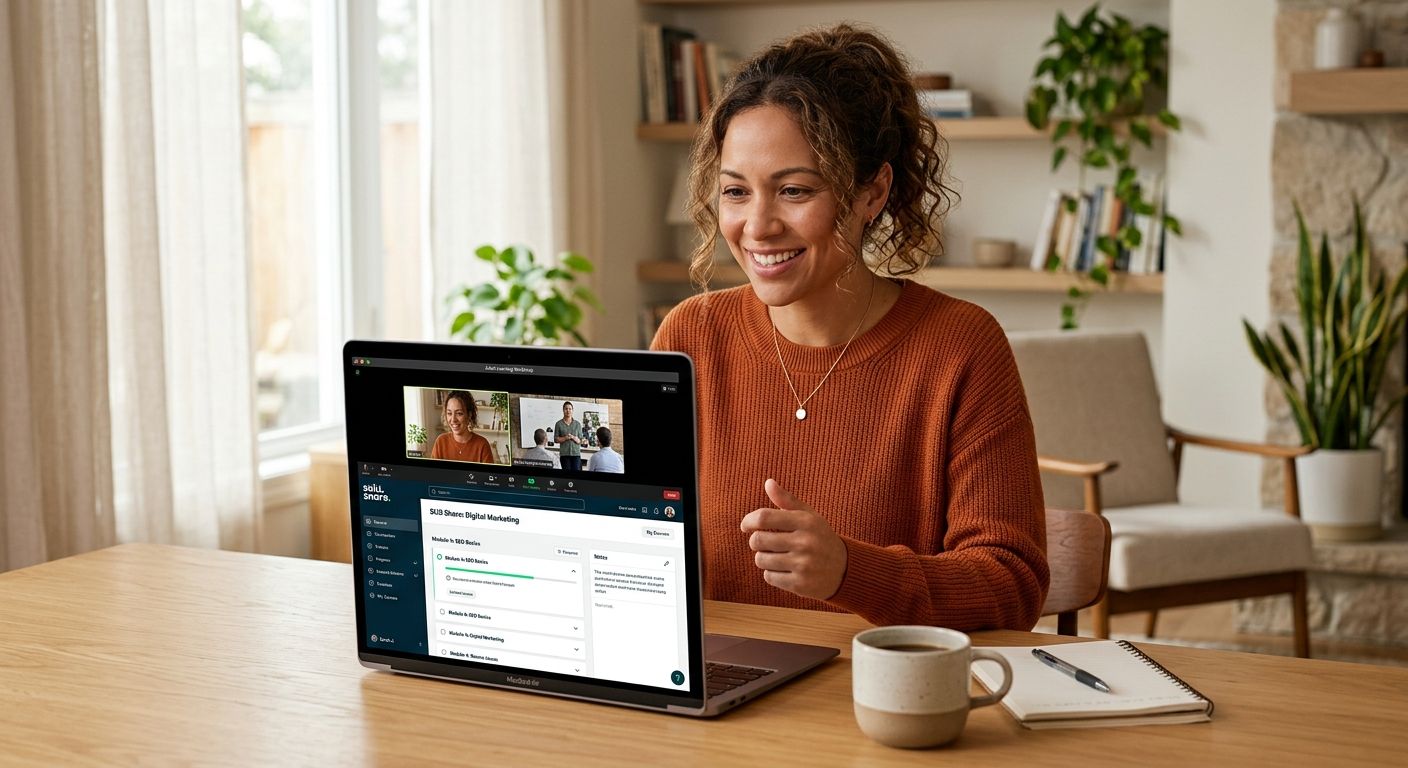
EdTech app development services cover the design, engineering, and delivery of learning applications — course platforms, live class tools, assessments, and learner analytics — with the aim of measurable learning outcomes and durable enrollment revenue for education companies, training providers, and schools. What makes online learning different from generic app work is the dual audience: the product has to keep learners engaged while giving administrators the reporting and control their institution demands.
TL;DR
- EdTech products live or die on learner engagement, not feature count.
- Scope a first release around one learning journey, end to end.
- Accessibility (WCAG) and student-data privacy shape architecture early.
- A custom partner fits when off-the-shelf LMS limits block your business model.
- Measure engagement weekly — session completion predicts renewal.
Why online learning platforms need purpose-built software
Learners abandon course platforms at a high rate when the experience feels like a file repository. Engagement is the product: streaks, progress visibility, live interaction, and feedback loops are what convert a signup into a completed course — and a completed learner into a renewal or a referral. Off-the-shelf LMS tools cover the basics, but the moment your business model depends on proprietary pedagogy, cohort-based programs, certification workflows, or monetization rules an LMS vendor does not support, generic software becomes the constraint.
The competitive bar also includes mobile-first delivery, offline access, and AI-assisted practice — features learners increasingly treat as standard. That is where custom app development earns its place: the product differentiates, and the platform follows your curriculum instead of the reverse.
1. Define the learning outcome you will be measured on
Buyers — school districts, corporate L&D leaders, or consumer subscribers — buy outcomes: test-score gains, job placement, compliance completion. Name the one metric your platform exists to move, and let it decide feature priorities.
- Course completion rate for consumer or cohort programs
- Skill assessment scores for workforce training
- Seat utilization and renewals for institutional buyers
- Time-to-first-lesson for activation tracking
2. Scope a first release around one complete journey
Pick one learner journey — enroll, learn, practice, get feedback, complete — and ship it end to end. A platform with ten half-finished features loses to one that reliably delivers a single satisfying loop. Defer community, gamification breadth, and marketplace features until the core loop proves retention.
3. Choose your delivery architecture
Video delivery, live classes, and assessments have very different infrastructure demands, and each decision shows up in your cost structure.
- Video: adaptive streaming with offline download support for mobile learners
- Live: WebRTC-based classrooms with attendance and recording built in
- Assessments: question banks, anti-cheat measures, and auto-graded formats
- Content model: authoring tools your own team can operate without engineering help
The right tech stack decision matters most on mobile: cross-platform frameworks carry a course app to iOS and Android with one team, while native earns its cost only when offline media or device-heavy features dominate.
4. Build accessibility and data privacy in from the start
Education software is regulated and scrutinized. WCAG 2.1 AA accessibility is a procurement requirement for institutional buyers, not a nice-to-have, and student data falls under FERPA in US schools, COPPA for younger learners, and GDPR in Europe. Retrofitting captions, keyboard navigation, and consent flows after launch costs multiples of building them in — and a failed accessibility audit kills an institutional deal outright.
5. Instrument engagement from day one
Track activation, weekly active learners, lesson completion, and drop-off points per course. These numbers decide what to build next and give your sales team proof for renewals. Where personalization pays off, AI integration services add adaptive pathways, automated feedback on practice work, and early-warning flags for learners at risk of churning — applied to your curriculum data, not a generic model.
6. Plan integrations your buyers already run
Institutional buyers evaluate your product against their existing stack: single sign-on (SSO/SAML), rostering standards like LTI, payment and invoicing systems, and HRIS feeds for corporate training. Naming your integration plan in the sales cycle shortens procurement; discovering an SSO gap after the pilot embarrasses everyone.
7. Decide what to build and what to partner on
Most education companies keep pedagogy, content, and customer relationships in-house and bring in an external team for delivery capacity. A dedicated development team works well here: product leadership stays with you while engineering executes against a roadmap you own. Syndell works this way with education and training businesses — extending the team on the platform, mobile, and integrations while your subject-matter experts drive the learning design.
Comparison: build paths for an online learning product
| Option | Best for | Key limitation |
|---|---|---|
| Off-the-shelf LMS | Standard course delivery, fast start | Business model constrained to the vendor’s feature set |
| No-code platform | Validating a course concept cheaply | Hits a ceiling on custom flows, data ownership, and scale |
| Custom development partner | Proprietary pedagogy, certifications, monetization control | Requires clear product ownership and a real roadmap |
Common mistakes EdTech founders make
- Copying a consumer social app’s engagement model into a professional training product
- Launching with five shallow features instead of one complete learning journey
- Treating accessibility as a post-launch cleanup item and losing institutional deals to it
- Building analytics dashboards nobody opens instead of one completion metric leadership trusts
- Underestimating content-operations effort — the platform ships, but nobody can load courses efficiently
One last thing
The strongest EdTech retention lever is not a feature — it is feedback speed. Platforms that return a grade, a coach comment, or a progress signal within minutes of a learner’s effort hold engagement measurably better than those that batch feedback overnight. Design your first release around that loop before adding anything else.