The business world rapidly evolves and staying competitive means embracing cloud and digital transformation. As companies move more of their data and workloads to the cloud, they can take advantage of new opportunities to increase efficiency, reduce costs, and improve their customers.
One of the most significant factors driving this transformation is cloud adoption, which allows organizations to optimize their operations, enhance their agility, and capitalize on emerging opportunities.
Many companies are turning to the cloud to support innovation, fast marketing, cost optimization, and scale efficiency while mitigating technology risks.
By utilizing a hybrid cloud operating model within a mission-critical environment, enterprises can extract valuable insights from sales and marketing data, supply chains, and other business information to create new services and applications for their target users.
Additionally, a multi-cloud strategy can accelerate business transformation by influencing technology selection, introducing new business models, and fostering innovative solutions. Multicloud environments enable enterprises to optimize their applications and effectively match workloads with appropriate cloud service providers, resulting in a significant advantage.
Need to migrate your data to the cloud but don’t know where to start?
Trust Syndell’s cloud adoption experts to guide you through the process and ensure a smooth transition.
Gartner projects that by 2025, over 65.9% of spending on application software will be allocated to cloud technologies, which marks an increase from 57.7% in 2022.

Source image – Gartner
According to a forecast by Statista, the global market size for cloud applications is to reach $168.6 billion (USD) by 2025, with an anticipated compound annual growth rate (CAGR) of 4.8%. These statistics highlight how organizations increasingly turn to the cloud to remain competitive in the digital age.
In this blog, we will explore the power of cloud adoption for enterprise digital transformation and discuss the latest trends, benefits of cloud adoption, and best practices for achieving success.
Ways to Use OpenAI GPT – 3 and ChatGPT for Business Data Analysis
What is Cloud Adoption?
Cloud adoption is the process whereby organizations and enterprises transition from conventional IT infrastructure to cloud computing. It involves relying on cloud services to provide resources and infrastructure instead of physical hardware or software.
By adopting cloud services, businesses can effectively decrease expenses, enhance efficiency, and boost scalability. It’s no wonder cloud adoption has gained popularity as organizations increasingly recognize its perks.
With cloud adoption, businesses can access resources on demand, which eliminates the need to pay for resources they don’t use. There’s no need for businesses to purchase and maintain hardware and software since they can access these resources through the cloud.
For businesses considering switching to the cloud, the process of cloud adoption can be broken down into the following steps:
1. Define goals and requirements
First, the company needs to identify why they want to switch to the cloud and what they hope to achieve. This can include cost savings, scalability, and increased efficiency.
2. Choose the right cloud provider
There are many cloud providers available, each with its own strengths and weaknesses. The company should carefully research and evaluate different providers to find the one that best meets their needs.
3. Select the appropriate cloud services
Once the provider has been chosen, the company needs to select the specific cloud services they will use. This can include Infrastructure as a Service (IaaS), Platform as a Service (PaaS), and Software as a Service (SaaS).
4. Plan for migration
Moving to the cloud requires careful planning to ensure a smooth transition. The company should create a migration plan that includes timelines, resource requirements, and potential risks.
5. Execute the migration
Once the migration plan has been created, the company can begin the migration process. This can involve moving data and applications to the cloud, as well as configuring and testing the new environment.
6. Optimize the cloud environment
After the migration is complete, the company should continue to monitor and optimize its cloud environment to ensure it is meeting its goals and requirements. This can involve adjusting settings, adding new services, or making other changes as needed.
Are you looking to transform your business with the latest in Cloud Adoption?
Read More About: Destructive & Optimistic effects on the digital market due to COVID-19
Role Of Cloud Computing In Digital Transformation
Let’s talk about something super exciting – digital transformation! I know, I know, it might not sound like the most thrilling topic, but trust me, it’s essential for the success of modern businesses.
Now, imagine this: you’re running a business in the 21st century, and you’re still using paper records to keep track of everything. Yikes! That’s like trying to compete in a marathon while wearing concrete shoes. You need to get with the times and embrace digital transformation.
So, what is digital transformation, you ask? Well, it’s all about using technology to improve your business processes and stay ahead of the competition. It’s not just about going paperless (although that’s definitely a good start), it’s about reimagining your entire operation to engage with customers in the digital age.
And that’s where cloud computing comes in. Cloud computing is like having a magic genie that can grant all your wishes for agility, scalability, and cost savings. It’s the perfect tool for businesses that need to keep up with the fast-paced digital landscape.
With cloud computing, you can access all the digital tools and storage you need from anywhere in the world. No more relying on onsite IT support, and no more worries about data privacy. It’s like having your own digital genie to help you work your magic!
So, if you want to stay ahead of the game and compete in the digital age, you need to embrace cloud and digital transformation services. They’re like the secret sauce that will make your business more efficient, effective, and competitive. So go ahead, unleash your inner digital genie, and transform your business today!
Components of Cloud Digital Transformation Strategy
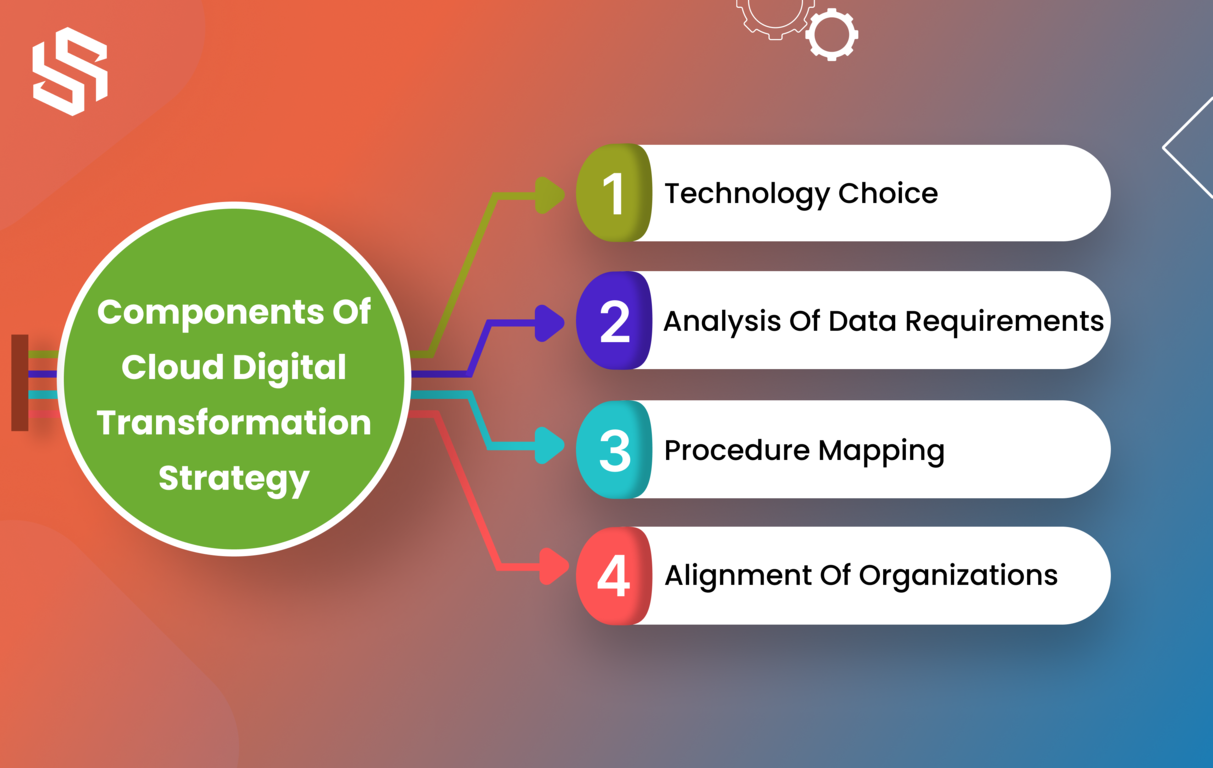
Cloud digital transformation is a critical aspect of modern business processes. To successfully implement cloud digital transformation, enterprises need a comprehensive strategy that takes into account their current structure, goals, and procedures. Here are the essential components of a cloud adoption strategy:
1. Technology Choice
Partnering with a cloud enablement partner helps to choose the right technologies and establish requirements. It’s crucial to identify legacy technologies that may hinder the overall growth path and cause experience bottlenecks.
2. Data Requirement Analysis
Before integrating data for the move, it’s vital to audit the present data and develop a knowledge base of the new data type. A reliable technology partner can provide a plan for this analysis.
3. Process Mapping
This is a crucial but challenging aspect of any strategy. The business process must center on how to better serve consumers by realigning resources and activities. More choices must be made in favor of modifications to the digital user interface that will ultimately benefit the user.
4. Organizational Alignment
The main focus of this step is developing an attitude of acceptance and cooperation. Change management can be handled quickly with committed IT reps and staff members who are experienced in communicating the new procedures. The goal is to ease organizational adjustments in almost every area of business following the transformation.
By following these essential components of a cloud digital transformation strategy, enterprises can accelerate their digital transformation, optimize different aspects of their business, and ultimately achieve success in the modern digital economy.
Cloud-enabled Digital Transformation Best Practices

To successfully implement digital transformation through cloud solutions, it is crucial to focus on key factors that will benefit your organization. Here are some essential steps to follow:
1. Concentrate on Participants:
Your staff is the first group of participants that should benefit from cloud solutions. Engage in open dialogue with them and identify areas of waste and potential growth. Also, seek feedback from your clients and business partners on the technology, information, software, and other elements currently offered by your organization.
2. Pay Attention to Data
As technology advancements are at the core of digital cloud transition solutions, rely on data while making decisions. Consult with IT experts and cloud service providers, if possible. Ensure that the data is safe and undamaged throughout the transition.
3. Make Your Objectives Clear
Identify the specific areas that need improvement, and focus on the final result of the modifications. Setting clear objectives helps to avoid getting lost in the numerous options and suggestions that cloud solutions offer. Keep in mind that accomplishing primary objectives opens the possibility of achieving more.
4. Revisit the Customer
The ultimate objective is to provide a more seamless and effective experience for your customers. After cloud migration for digital transformation is complete, continue the open discussion and be receptive to any pain points or innovative solutions provided by customers.
5. Be More Efficient
Digital transformation through cloud solutions is a quick and effective procedure that aims to improve your future products. Create a schedule for your digital transformation with the help of a trustworthy partner offering cloud services. Implementing several transitions at once will minimize downtimes and provide reliable access.
By following these steps, your organization can smoothly implement digital transformation through cloud solutions, leading to improved efficiency, productivity, and customer satisfaction.
Read More About: Benefits and Challenges of Cloud-Based Learning Management Systems
Benefits of Cloud Adoption for Enterprise Digital Transformation

Let me tell you all about how moving to the cloud can help businesses save money, enhance security, and boost innovation!
1. Say goodbye to costly hardware and software!
Moving to the cloud means businesses can say goodbye to pesky on-premises hardware and software. These things can be a real headache to maintain and upgrade, not to mention expensive!
But with cloud computing, businesses can enjoy pay-as-you-go pricing models, meaning they only pay for what they use. That’s music to our ears, and it can lead to some serious cost savings for small businesses.
2. Your data will be as safe as Fort Knox!
Worried about security? Don’t be! Cloud providers have robust security measures, including encryption, access controls, and data backup and recovery.
By moving your data and applications to the cloud, you can benefit from these advanced security measures without breaking the bank on the costly security infrastructure. It’s like having your own personal army of cyber-security experts keeping your data safe!
3. Innovation and agility? Yes, please!
Cloud computing can help businesses innovate and be more agile. With the cloud, businesses can experiment with new ideas and technologies more quickly and easily without having to invest in expensive infrastructure or software.
Plus, businesses can scale up or down quickly in response to changing demand or market conditions. That’s essential for businesses with rapidly changing needs, like a chameleon changing colors to blend into its environment!
4. Get flexible and scalable!
Cloud adoption can help businesses be more flexible and scalable. With the cloud, businesses can quickly and easily scale their IT infrastructure up or down to meet changing demands.
Plus, cloud computing enables businesses to retrieve data and utilize applications from any device, location, or time. That means employees can work from wherever they want, whenever they want. It’s like having your own personal work-cation!
5. Faster deployment? Yes, please!
With cloud computing, businesses can quickly deploy their applications without investing in expensive hardware or software. It’s like magic!
Plus, cloud computing enables businesses to test and develop their applications more quickly, using tools and services designed for rapid iteration and deployment. That means businesses can launch new products and services more quickly than ever before!
6. Automation? Let the robots do the work!
Cloud adoption can create automation opportunities for businesses. By leveraging cloud-based automation tools and services, businesses can automate routine and repetitive tasks, freeing their employees to focus on more strategic and value-added activities.
Plus, cloud computing enables businesses to collect and process large amounts of data, which can be used to develop advanced analytics and machine learning models to enhance automation further. It’s like having your own army of robots taking care of the boring stuff so you can focus on the fun stuff!
So there you have it, folks! Moving to the cloud can help businesses save money, enhance security, and boost innovation. It’s like having your own personal genie granting all your business wishes!
How has the healthcare industry benefitted from Automation?
Ready to discuss your Project?
Get in touch with our team to discuss your project requirements and get a customized solution that meets your needs.
Digital Cloud Transformation Solutions
Cloud-based digital transformation solutions offers a range of options to businesses seeking to modernize their operations. Three common approaches are Platform as a Service (PaaS), Software as a Service (SaaS), and Infrastructure as a Service (IaaS).
1. Platform as a Service (PaaS)
PaaS involves using a third-party platform for application development, with the cloud service provider overseeing servers, storage, security, and networking. This allows development teams to focus on creating and managing unique applications.
2. Software as a Service (SaaS)
SaaS delivers third-party managed software over the internet, which can be used by clients or within the company as needed. Applications are provided on-demand, frequently through a web browser, reducing the need for downloads.
3. Infrastructure as a Service (IaaS)
IaaS is the most comprehensive option, offering computing resources such as software, hardware, databases, and platforms for businesses to create their own apps. Resources can be purchased as needed, allowing for flexibility in response to changing computing requirements.
To choose the best cloud-based digital transformation solution, businesses should assess their needs, including transferring legacy technology and anticipating future needs based on their objectives. An audit of current systems can help identify requirements, and the appropriate cloud solution can then be selected to achieve success.
Top 13 Artificial Intelligence Applications in Banking Industry
Ready to take your online presence to the next level?
Contact Syndell today for top-notch mobile and web development services.
Conclusion
Hey there, tech-savvy entrepreneurs!
Are you ready to embrace the power of the cloud and take your business to new heights? With cloud adoption, you can kiss goodbye to the outdated on-premises hardware and software that have been holding you back.
By migrating to the cloud, you can enjoy cost efficiency, enhanced security, innovation, agility, scalability, flexibility, faster deployment, and automation opportunities. In short, the cloud has got it all covered.
But don’t just take our word for it – let Syndell be your trusted partner in the cloud. Our team of experts will help you navigate the complexities of cloud adoption and unlock the full potential of your business.
So why wait? Contact us today to schedule a consultation and see how Syndell can help you achieve your digital transformation goals. Let’s soar to the cloud together!