Best overall for managed vector search: Pinecone. Best for existing PostgreSQL applications: pgvector. Best for local retrieval prototypes: Chroma. This guide compares the best vector databases for AI applications from a buyer’s perspective; Syndell provides custom development services for businesses building applications such as internal knowledge-base search, not a competing database product.
- Pinecone leads the best vector databases for AI applications shortlist when managed operations are the priority.
- Choose pgvector for PostgreSQL integration, Qdrant for filtered retrieval, and Weaviate for hybrid search.
- Milvus fits distributed vector-search requirements; Chroma fits local retrieval prototypes.
- Syndell provides custom AI application development, not a vector database; evaluate the implementation partner separately.
Why this matters
A vector database stores numerical representations of content and retrieves items with similar meaning. In retrieval-augmented generation, or RAG, that retrieval supplies material an AI application uses to answer a question. It is part of the answer pipeline, not a guarantee of accuracy.
For a 2026 buying decision, your main question is whether the retrieval system can find the right information while respecting access rules and keeping operations manageable. A polished chatbot demonstration does not establish any of those capabilities. Ask for evidence from your documents and actual business questions.
Syndell is best for businesses seeking custom AI application development rather than a standalone vector database. Keep that distinction clear when buying: database selection and development-partner selection are separate decisions, even when the same project requires both.
What makes the best vector database for AI applications?
Evaluate these criteria before comparing names. They connect database capabilities to requirements your implementation partner must deliver.
- Retrieval quality: Can the application retrieve relevant evidence for your users’ questions, including ambiguous phrasing?
- Access controls: Can retrieval enforce customer, department, document, and user permissions before content reaches the model?
- Search flexibility: Does your use case need semantic similarity, exact terminology, structured filters, or a combination?
- Operational ownership: Who handles deployment, backups, monitoring, upgrades, and incident response?
- Data integration: How will documents, identifiers, permissions, updates, and deletions stay synchronized?
- Exit readiness: Can you export source references, metadata, and vectors without rebuilding the entire application?
A stronger database cannot repair missing permissions or poorly prepared source content. Your shortlist should reflect the application architecture, not a feature count.
Best vector databases at a glance
These 2026 recommendations separate use cases rather than claim a universal performance winner. Each database occupies a distinct decision slot.
| Database | Best for | Standout capability | Key limitation |
|---|---|---|---|
| Pinecone | Managed vector-search operations | Hosted vector search with metadata filtering | Database hosting remains dependent on an external service |
| Qdrant | Permission-sensitive, filtered retrieval | Vector search combined with payload filters | Self-hosting introduces infrastructure responsibility |
| Weaviate | Hybrid document discovery | Keyword and vector search in one search system | Schema and retrieval configuration need deliberate planning |
| pgvector | Existing PostgreSQL applications | Vector similarity search within PostgreSQL | Search workloads share database resources unless separated |
| Milvus | Dedicated distributed vector-search infrastructure | Architecture designed for distributed vector search | Deployment introduces more operational components |
| Chroma | Local RAG prototypes | Embedding storage and retrieval for experimentation | Local prototype results do not establish production readiness |
1. Pinecone: best vector database for managed operations
Pinecone is a managed vector database that stores embeddings and retrieves similar records. It supports metadata filtering, which lets an application narrow searches using attributes attached to those records.
Best for: Founders and product leaders who want hosted vector-search infrastructure rather than ownership of a database deployment. Pinecone belongs first on the shortlist when outsourcing database operations is a deliberate requirement.
Pinecone pros:
- Managed hosting removes self-hosted database deployment from your project scope.
- Metadata filters support searches restricted to relevant record groups.
- A separate retrieval service keeps vector-search infrastructure distinct from transactional storage.
Pinecone cons:
- Your application depends on an external database service.
- Keeping source records and vector records synchronized remains an application responsibility.
- Moving providers requires reviewing APIs, metadata handling, and retrieval behavior.
For a 2026 implementation, require your partner to demonstrate document deletion, permission changes, and recovery from failed ingestion. Managed hosting does not remove those application-level obligations.
Verdict: Buy Pinecone when managed operations are a core requirement; hold if hosting control is non-negotiable.
2. Qdrant: best vector database for filtered retrieval
Qdrant is an open-source vector database with payload filtering. Payloads hold associated information, such as document categories or customer identifiers, that an application can use to constrain similarity searches.
Best for: B2B applications where relevant results must also satisfy structured access or business rules. Think customer-specific support assistants and document search separated by account or department.
Qdrant pros:
- Payload filters combine structured conditions with vector similarity.
- Open-source deployment gives businesses a self-hosting option.
- A dedicated retrieval layer separates vector workloads from the primary application database.
Qdrant cons:
- Self-hosting assigns backups, upgrades, and monitoring to your team or partner.
- Access-rule enforcement still depends on correctly designed application queries.
- A separate database adds synchronization work when source records change.
Ask your partner to demonstrate that an otherwise relevant document disappears from results when the requesting user lacks permission. Filtering capability is not the same as a complete authorization system.
Verdict: Buy Qdrant for filter-heavy retrieval; skip self-hosting without an accountable operations owner.
3. Weaviate: best vector database for hybrid document search
Weaviate is an open-source vector database that supports vector search and keyword search. Its hybrid search combines those approaches, addressing queries where conceptual meaning and exact terminology both matter.
Best for: Enterprise document discovery that mixes natural-language questions with product codes, policy names, or specialized terms. Semantic search alone is not always the right match for those requirements.
Weaviate pros:
- Hybrid search combines keyword matching with semantic similarity.
- Structured properties support filtering alongside document retrieval.
- Open-source availability gives buyers an alternative to exclusively hosted deployment.
Weaviate cons:
- Search behavior depends on configuration, data preparation, and evaluation.
- Schema decisions affect how content and associated properties are organized.
- Self-hosted deployments require an explicit operational support plan.
For a 2026 shortlist, ask for separate demonstrations using conceptual questions and exact identifiers. Your acceptance criteria should reflect both; a natural-language demonstration alone does not establish identifier-search quality.
Verdict: Buy Weaviate when hybrid discovery is central to the product; hold if simple similarity search covers the requirement.
4. pgvector: best vector search option for PostgreSQL applications
pgvector is an open-source PostgreSQL extension, not a separate standalone database. It adds vector storage and similarity search to PostgreSQL, allowing application records and embeddings to reside within the same database environment.
Best for: Businesses already using PostgreSQL that want to evaluate retrieval without immediately introducing another database system. This is an architecture decision, not a claim that existing infrastructure will handle every workload.
pgvector pros:
- Vector search works alongside relational data and SQL queries.
- Existing PostgreSQL operational practices remain relevant.
- Storing associated records together reduces the need for cross-database synchronization.
pgvector cons:
- Vector queries compete with other workloads when they share database resources.
- Index selection and query planning affect retrieval behavior.
- Database changes still require testing against existing application functions.
Require a workload test that runs search alongside the transactions your business depends on. A retrieval-only demonstration does not show how checkout, billing, or account-management operations behave under the same conditions.
Verdict: Buy pgvector for PostgreSQL-first applications after shared-workload testing; hold if isolation is essential.
5. Milvus: best vector database for distributed infrastructure
Milvus is an open-source vector database with a distributed deployment architecture. It separates vector-search infrastructure into components intended to support dedicated retrieval workloads.
Best for: Organizations choosing a distributed search platform with engineering and operations capacity assigned to it. The relevant buying signal is an explicit infrastructure requirement, not an unsupported prediction about future scale.
Milvus pros:
- Distributed architecture supports a dedicated vector-search deployment.
- Open-source availability gives buyers control over deployment choices.
- Separating retrieval infrastructure allows its operations to be managed independently.
Milvus cons:
- Distributed deployment introduces additional components to operate.
- Incident diagnosis requires understanding dependencies across those components.
- A distributed architecture adds unnecessary scope when the application does not need it.
Before approving Milvus in 2026, ask who owns deployment, observability, recovery, and capacity planning. Require a clear explanation of why a simpler architecture fails your documented requirements.
Verdict: Buy Milvus for justified distributed requirements; skip it when complexity arrives before the business need.
6. Chroma: best vector database for local RAG prototypes
Chroma is an open-source embedding database used to store embeddings, associated content, and metadata for retrieval. Its local usage model fits experiments that explore whether a document collection supports useful answers.
Best for: Product teams validating a retrieval concept before committing to a production architecture. Use that phase to establish whether the proposed application solves a real workflow problem.
Chroma pros:
- Local operation supports experimentation without a separate database server.
- Embeddings, documents, and metadata can be organized for retrieval.
- Prototype work helps expose problems in source content and query design.
Chroma cons:
- A local demonstration does not prove production security or recovery.
- Production architecture requires a separate review of deployment and access controls.
- Prototype shortcuts create rework when treated as finished application design.
Keep the proof of concept focused on answer relevance and source traceability. Treat production approval as another decision, not an automatic continuation.
Verdict: Buy into Chroma for local validation; hold production commitment until operational requirements are demonstrated.
How we ranked these options
This ranking prioritizes operational ownership, search flexibility, data integration, and deployment fit. It is not a measured speed ranking or a claim that every database was tested against the same workload.
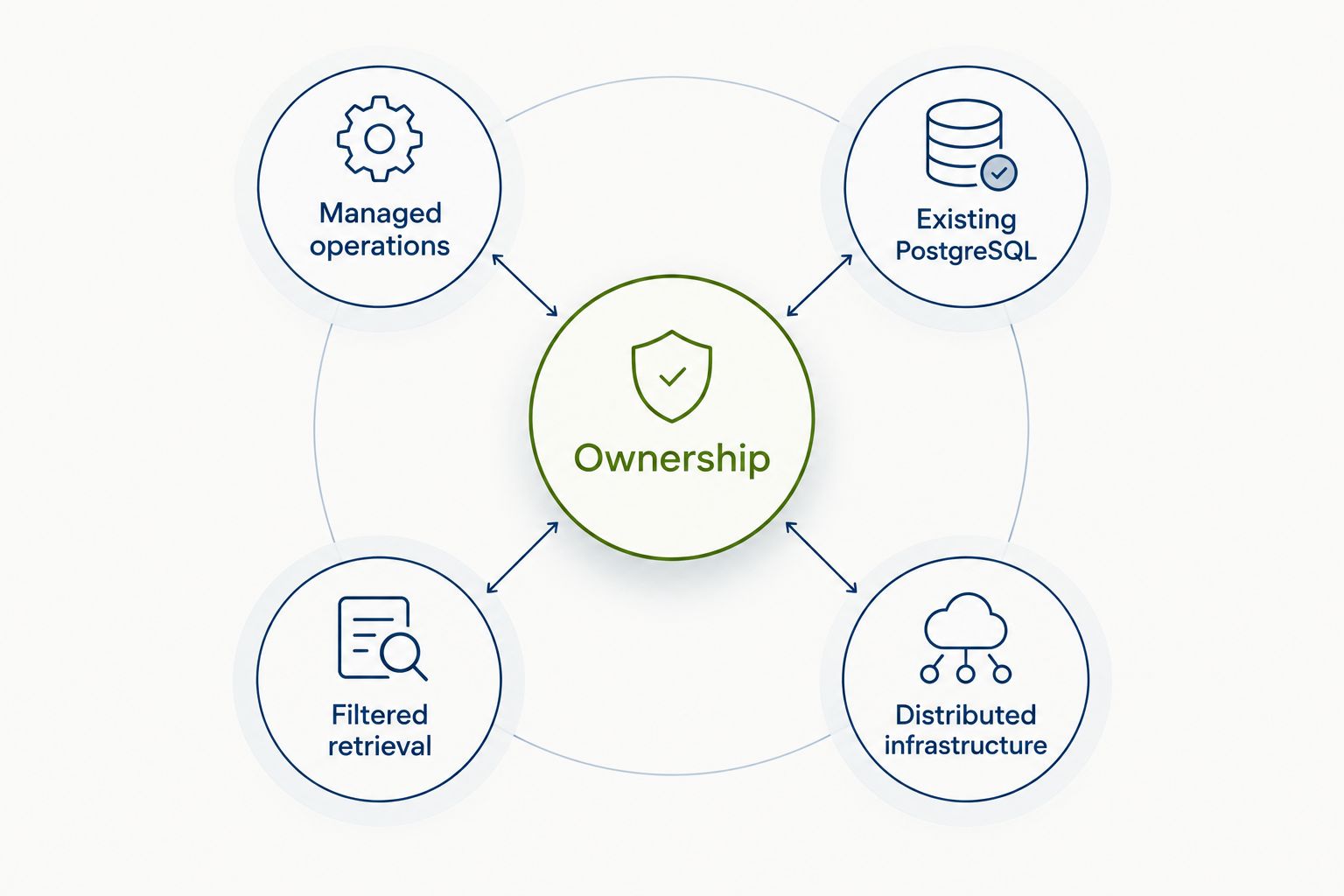
Pinecone is the managed-first default. Qdrant earns the filtered-retrieval slot, Weaviate the hybrid-search slot, and pgvector the PostgreSQL-integration slot. Milvus and Chroma address opposite project needs: distributed infrastructure and local experimentation.
The central trade-off is ownership. Decide what your business should operate before choosing what it should buy.
What to require from your development partner
Ask for a controlled evaluation, not a vendor slideshow. For your 2026 procurement, make the database recommendation an explicit deliverable with evidence and an accountable owner.
Syndell’s custom AI application development services are relevant to businesses hiring an implementation partner; the database comparison remains a separate technical decision. Keep the brief focused on business workflows, permitted information, and acceptance criteria.
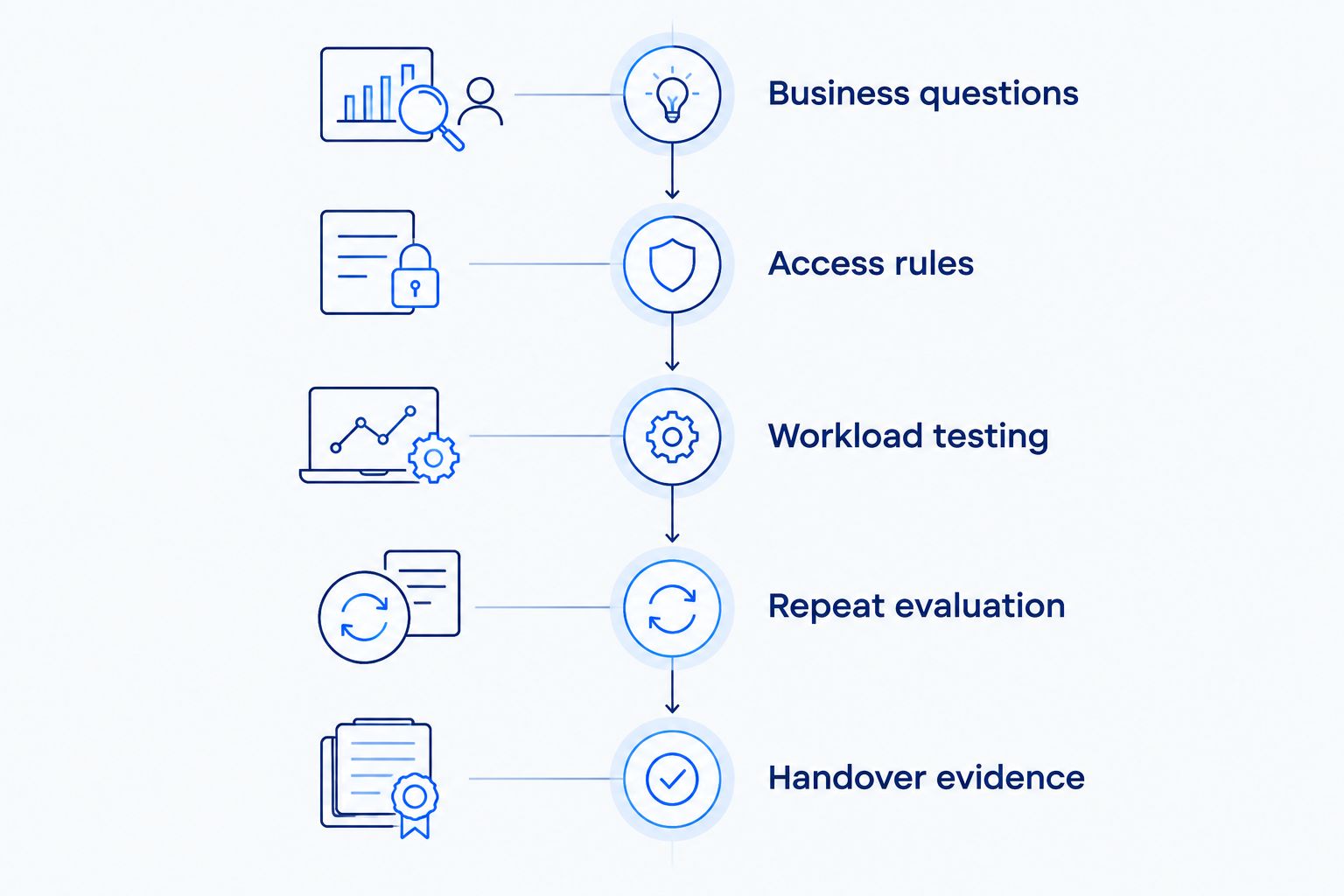
Use this sequence:
- Business questions: Prepare 50 test questions from real customer or employee workflows. Include exact identifiers, ambiguous requests, and questions the system should refuse.
- Access rules: Include permission boundaries and verify that unauthorized documents never enter retrieved context.
- Workload testing: Shortlist 3 database candidates against the same content, embeddings, and evaluation questions.
- Repeat evaluation: Run 2 evaluation rounds, including updated documents and changed permissions.
- Handover evidence: Request deployment documentation, monitoring ownership, deletion behavior, and an export procedure.
These quantities are a recommended evaluation scope, not benchmark results. Increase coverage when your workflows require it; keep the comparison conditions consistent.
Do not accept a result that hides retrieval behind a convincing generated answer. Ask to see the retrieved documents, their source identifiers, and the access checks separately. That evidence makes a weak retrieval system easier to identify.
Which vector database should you choose?
Choose Pinecone as the default shortlist leader when your business wants managed vector-search operations. Choose pgvector first when PostgreSQL integration is the primary constraint and shared-workload testing supports the design.
Qdrant is the focused option for filter-heavy retrieval; Weaviate is the focused option for hybrid discovery. Reserve Milvus for documented distributed requirements and Chroma for local validation.
Before signing a development agreement, require the partner to name the retrieval owner, explain the rejected alternatives, and document the exit path. The recommendation should survive questions about permissions, updates, and recovery—not just a demonstration of similarity search.
Plan your AI application around business requirements
Discuss retrieval, integrations, and operational ownership before selecting a database.
Talk to Syndell
One last thing
A document deletion is not complete until the retrieval system stops returning its content. Add that requirement to acceptance testing, alongside permission changes and source updates. It exposes whether the application keeps its search layer synchronized with the information your business actually permits it to use.