

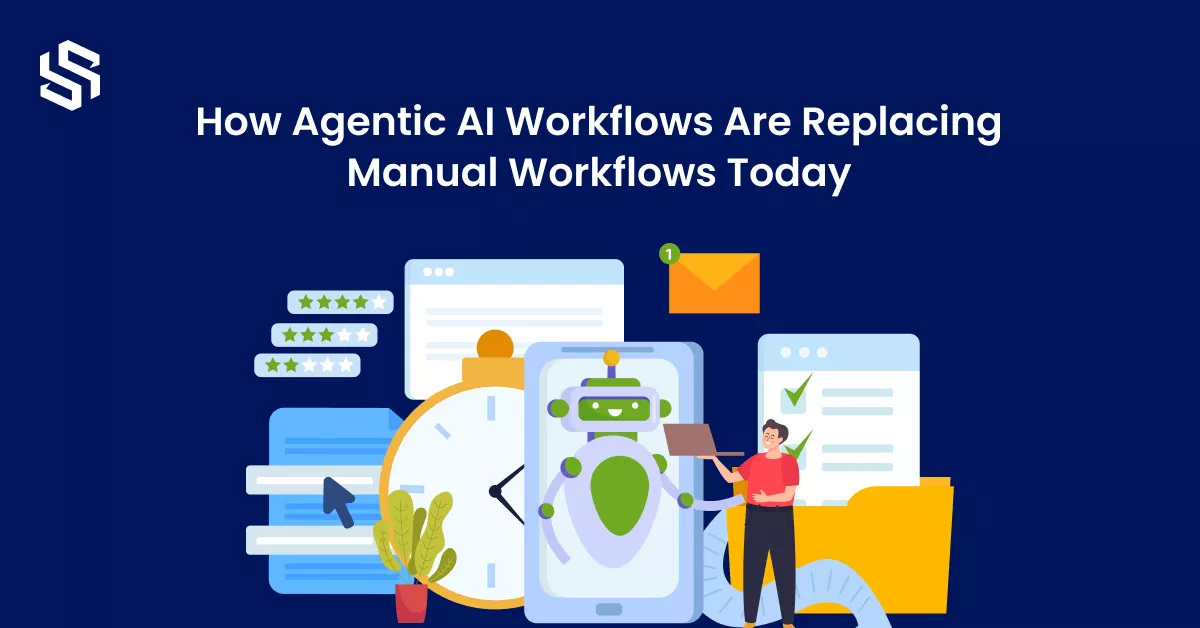
Every business is burdened by the same fact: manual processes are labor-intensive and time-consuming. Data entry, document processing, and a myriad of other manual workflow tasks result in a surprising amount of time lost that could be invested in more valuable, strategic work. While traditional automation techniques provide some relief, they do nothing to help with workloads that require changing activity and decision-making. This is where the automation magic of agentic automation comes in. Agentic automation is the ability of AI to be the agent of a manual process workflow on an autonomous basis, from start to finish.
Workflow automation services in the USA are undergoing a complete transformation. Corporations using AI workflow automation experience about a 70% decrease in time taken to process a task and 40% in operational costs. The change is not only about speed but also about the development of systems that are able to operate without constant human supervision and learn, think, and evolve on their own.
What is Agentic AI Automation?
Agentic AI automation is the latest form of workflow automation. Unlike systems that are based on a set of business rules and follow process flows, agentic systems are powered by AI of autonomous agents, which can:
- Make decisions independently based on context
- Adapt to a business environment that is constantly changing
- Perform multiple tasks in collaboration with other systems on various tiers
- Debrief when a task is assigned to them and the system is not able to complete it
- Learn from experience and develop
Imagine agentic automation as a workforce of digital employees that are not rote but understand the task and figure out the most efficient way to achieve it. The agents are able to collaborate, resolve most of the exceptions on their own and only escalate when absolutely necessary.
Moving from Manual Work To Automated Work Processes
There are three different phases to moving from manually completed processes to automated processes:
Phase 1: Manual Work Processes
In this phase, fully manual processes were completed by a person without any form of automation. For example, the invoice approval processes required manual data input, the approvers were required to email each other, physical approvals required manual signing, and spreadsheet updates that needed to be completed because the process was at the step to be updated.
Phase 2: Rule-Based Automation
With the introduction of new automation tools, if-then logic was implemented, which helped decrease the amount of manual work. However, there were issues with these new automated processes, as they were if-then logic so they were not able to make exceptions to the rules that were placed. These processes became a higher maintenance issue as business rules changed more frequently.
Phase 3: Agentic Automation
Modern Agentic AI Automation Services have the capability to fully process complex workflows with no need for human supervision. These systems don’t just create more available work for humans by automating individual tasks; they take supervision and reallocate that to a human process so that the human does not need to be involved in the system.
Enhance your travel app with AI-driven automation that streamlines bookings, elevates customer experiences, and boosts overall operational efficiency.
Advantages Gained from Automated Work Processes
Many companies that have chosen to implement Workflow Automation Solutions in the USA are reaping the benefits.
1. Increased Productivity
Computers, and specifically the AI that empowers automation processes, are able to work 24/7 without the need for breaks. They are able to complete work at a pace that is 10x faster than a human. For example, the customer onboarding process that would take 3 days to complete is now able to be completed in a matter of hours.
2. Improved Accuracy and Compliance
Models have more than a 99% success rate when it comes to accuracy in data processing. For industries like finance and healthcare, this fundamental value mitigates compliance and audit risks.
3. Effortless Scalability
The traditional method of scaling a business while successfully running it is to hire more employees. However, with AI solutions for businesses, to manage a workload of 10x, one needs to invest only 20% more in business infrastructure.
4. Active Exception Handling
AI is able to analyze the situation and make decisions about whether or not to escalate to a human when there is an anomaly in the workflow. There is a defined threshold in situations when a human is needed to make a decision.
5. Ongoing Improvements and Optimization
Most other forms of business process automation other than agentic systems are stagnant and do not strive to continually improve the system. These systems attempt to remove bottlenecks by improving the system to work based on the patterns of real data.
Read More About: AI-Powered Chatbots: Transforming the Future of Travel Services
Across Industries: The Real Impact
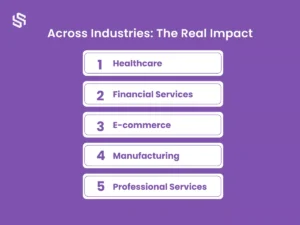
AI automation systems are processing workflows in multiple industries and continually improving them:
Healthcare
AI takes charge of patient scheduling, verification of insurance, processing of claims, and updating and maintaining medical records. One case study showed a hospital network that improved patient satisfaction by speeding up appointment scheduling and billing and gained a 60% reduction of administrative costs all at the same time.
Financial Services
AI workflows are now fully operational in systems of banks and other financial institutions to automate the processing of loans, detection of fraud, monitoring of compliance, and providing of customer service. Because of this, banks were able to reduce the time needed to approve loans by 50% and fraud losses by 80%.
E-commerce
AI-managed order processing, inventory management, customer interactions, and returns management are all linked. Top retailers manage peak shopping seasons without hiring temporary staff.
Manufacturing
Agentic automation for supply chain coordination, quality control monitoring, predictive maintenance scheduling, and production optimization reduces downtime by 40% and improves product quality.
Professional Services
AI agents in document review, research synthesis, communication, and project management provide faster turnaround times without sacrificing quality.
Agentic Automation and Traditional Automation
Agents Technology’s approach is very different from the basic automation techniques. It’s the first step in evaluating Custom AI Development Services:
Criteria | Tradition Automation | Agentic Automation |
Choosing Actions | Unitary action | Pluralistic actions |
Behavior Changes | Changes have to be manual | Changes have to be manual |
Handling Cases | Only goes through a case | Goes through a case |
Installation Difficulty | One system to another | From any system to any other system |
System Maintenance | Needs constant adjustments | System adjusts itself |
Traditional robotic process automation (RPA) does the basic work of shifting data from one platform to another. Agentic automation goes the extra mile by considering the data, validating the quality, adjusting any errors, and sending accurate data to the next platform without any human work.
Stay ahead in the competitive travel industry by integrating intelligent automation for faster bookings, smarter pricing, and better customer retention.
AI-Engineered Workflow Solution Automation
Workflow automation services have to work well to help in automation. Workflow automation USA gives more emphasis to:
First Step
The first step is to analyze and prioritize the process. From the processes at hand, focus on the ones that have the most volume and have repetitive tasks. Start with the processes that have the most pain in order to gain more wins with the automation system in place.
Phase 2: Data Preparation and Integration
AI requires high-quality data and unimpeded access to data across systems. Assess current data sources, purge data sets, and develop structures for integration to be done before going live.
Phase 3: Pilot Implementation and Testing
Start small and closely track performance. Before scaling, collect data from users, assess impact from the metrics established, and gather data from users.
Phase 4: Scaling and Optimization
If it works, increase the reach of the automation to other departments and processes. Use insights from the initial implementations to sprint to the finish.
Phase 5: Continuous Improvement
With modern AI-powered workflow automation, you can’t set it and forget it. It needs to be reviewed frequently to keep up with the tune of the business and use new AI features as they become available.
Success Factors
Organizations that get the best results from agentic automation do the following:
Executive Sponsorship
Ensuring leadership support for the commitment of needed resources and fostering the culture.
Change Management
Employees have to be educated and comforted around how their role is being augmented by AI, and it’s freeing them to do more of the high-value work.
Realistic Expectations
Agentic automation is powerful, but it also isn’t magic. Setting achievable wins keeps the project momentum moving and avoids disappointment.
Security and Governance
The strength of the frameworks is the degree to which AI agents are allowed to operate in the open, what it means for sensitive data and the rules around compliance.
Partner Selection
When working with seasoned experts in Custom AI Development Services, the speed at which the implementation is done increases and the risk is reduced significantly, which is achieved by means of utilizing proven methodologies in conjunction with collaborative technical experience.
Read More About: The Biggest AI Development Trends Set to Shape Businesses in 2025
The Future of Work: Human-AI Collaboration
Agentic automation does not take away jobs; it takes away the most tedious and redundant tasks. Employees being able to escape undergo an increase in their job satisfaction and engagement. Sales team members concentrate on the more important aspect of their jobs: building relationships, while the tedious data-entry work is done by an AI agent. Instead of generating reports, analysts fully concentrate on their primary responsibility, which is valuable interpretation of the data. Customer service representatives solve complicated issues, requiring empathy and creativity, and leave the rote tasks like password resets to the AI.
The most successful organizations are the ones that understand AI agents are new digital teammates, and together, they use the unique capabilities of each to create and implement new strategies. This, in turn, focuses on areas of innovations, relationships, and management. The success of the digital and human collaboration cannot be achieved by automation or human effort working in isolation.
Conclusion
The shift from manual processes to agentic automation is not just about operational efficiency; it is an introduction of a new way of functioning at the core of the company. Organizations that implement workflow automation solutions in the USA are able to gain unprecedented speed, accuracy, and scalability when they automate processes and move away from manual processing.
The gap between organizations that use agentic automation and those that rely on manual processes will continue to grow as the technology advances. Those that have adopted such a technology are already experiencing benefits, such as faster time to market, improved customer experience, and operational costs that scale with growth.
Syndell has a lot of experience building and putting into action AI workflow automation solutions that are tailored to how your company does business. Our AI specialists serving the United States, the UK, the UAE, Canada, and Australia couple technical skills and knowledge of the sector with the ability to shift automation initiatives. Whether you are updating your old workflows or creating new operations that are AI-driven, we have the strategic expertise and technical know-how to achieve effective implementations. Let’s work together to change your manual processes into intelligent, self-driving workflows that give you a long-lasting edge over the competition.